 2021, Vol. 38
文章信息
- 黄瑶, 史佳宁, 张振贤, 陈若宏, 吴梓堇, 王拯
- HUANG Yao, SHI Jianing, ZHANG Zhenxian, CHEN Ruohong, WU Zijin, WANG Zheng
- 慢性疲劳综合征主要中医证型患者认知功能特点的研究
- Study on cognitive function characteristics of patients with chronic fatigue syndrome of main traditional Chinese medicine syndrome
- 天津中医药, 2021, 38(1): 37-42
- Tianjin Journal of Traditional Chinese Medicine, 2021, 38(1): 37-42
- http://dx.doi.org/10.11656/j.issn.1672-1519.2021.01.09
-
文章历史
- 收稿日期: 2020-08-15


慢性疲劳综合征(CFS)是以长期存在或反复发作(时间不少于6个月)的疲劳为主要且首发症状,并伴有低热、咽喉疼痛、无红肿的多关节疼痛、与以往不同的头痛等躯体症状,以及短期内的记忆力减退、注意力下降、睡眠障碍等精神心理症状的一组原因不明的症候群[1]。课题组前期研究成果及相关文献表明[2-3],肝郁脾虚证、肝肾不足证、气滞痰阻证和心脾两虚证为CFS主要中医证型。本研究探讨CFS的认知特点以及轻度认知功能受损患者在主要中医证型中的分布,为临床防治CFS患者认知功能受损提供思路。
1 材料与方法 1.1 受试者来源128例CFS患者为2017年5月—2018年2月于上海中医药大学附属岳阳中西医结合医院内科门诊及病房、CFS专科门诊就诊的患者,其中肝郁脾虚组、肝肾不足组、心脾两虚组和气滞痰阻组各32例。正常组32例来源于岳阳医院体检中心体检指标正常者及健康志愿者。
1.2 诊断与分组标准 1.2.1 西医诊断标准CFS的诊断参照“美国疾病控制中心(CDC)制定的CFS诊断标准”[1]。
1.2.2 中医分组标准根据2002年《中药新药临床研究指导原则》、课题组既往研究成果并结合临床实际拟定肝郁脾虚证、肝肾不足证、气滞痰阻证和心脾两虚证4个中医证型分组标准[2, 4]。相应证型主症中必须包括“神疲乏力”。
1.3 纳入标准各组纳入病例均男女不限,年龄18~55岁,右利手,知情同意。CFS患者须符合CFS诊断标准及中医分组标准;正常组纳入病例须无疲劳病史。
1.4 排除标准具有临床上已明确诊断的其他疾病者;因器质性疾病而导致的疲劳患者;器质性精神障碍者;重度情感障碍者;有严重自杀倾向者;4周内有急慢性感染、外伤、手术史者;妊娠期、哺乳期女性;色盲;药物和(或)乙醇滥用者。
1.5 剔除标准无法遵循研究方案要求,无法配合研究者完成相关测试项目者;受试者自动退出研究;缺少主要数据,无法进行统计者。
2 研究方案 2.1 样本量估算与分组本研究受试者分为CFS主要中医证型(肝郁脾虚组、肝肾不足组、气滞痰阻组、心脾两虚组)和正常组,共5组。采用公式n=ψ2(∑Si2/g)/[∑(xi-x)2/(g-1)],取α=0.05,β=0.1,查表得ψ=1.96;根据课题组前期预试验结果,估计各组MoCA总分均数分别为26.5、25、27、26、28分,标准差分别为3.4、3.9、2.9、3.5、1.8分,估算得各组样本量为31例。
2.2 观察指标及测试方法 2.2.1 生物学指标记录人口学特征:性别、年龄、职业、婚姻、文化程度;记录生命体征:体温、呼吸、血压、心率。
2.2.2 认知功能测评指标 2.2.2.1 蒙特利尔认知评估(MoCA)量表采用Nasreddine等于2004年制定,由北京解放军总医院解恒革翻译的MoCA量表[5]进行认知功能障碍筛查。根据评分标准判为正常、轻度、中度及重度认知功能障碍。若受试者受教育年限小于12年,则在测试结果上加1分,用于校正受教育程度的偏倚。
2.2.2.2 E-prime认知心理学测试分别采用B反应时(BRT)、经典快速序列视觉呈现(RSVP)和One-back字母匹配任务进行认知心理学测试。BRT结果中,反应时=总反应时间/40;RSVP结果中,目标字母T1正确率=T1回答正确的次数/40,目标字体T2|T1的正确率为T1回答正确的前提下,T2的正确次数/正确回答T1的次数[6];One-back字母匹配任务中,正确率=回答正确的次数/40。
2.3 统计学分析采用IBM SPSS 21.0软件进行统计分析。服从正态分布的计量资料,以均数±标准差(x±s)表示,运用单因素方差分析进行多组间均数比较;不服从正态分布的计量资料,以中位数和四分位间距M(Q1,Q3)表示,运用秩和检验分析;计数资料运用卡方检验分析,P < 0.05为差异具有统计学意义。
3 研究结果本研究实际纳入受试者168例,因未完成研究相关测试或缺少主要研究数据而剔除8例。最终,各CFS主要中医证型组和正常组各纳入32例。
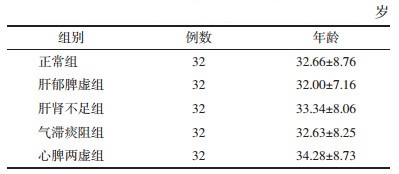
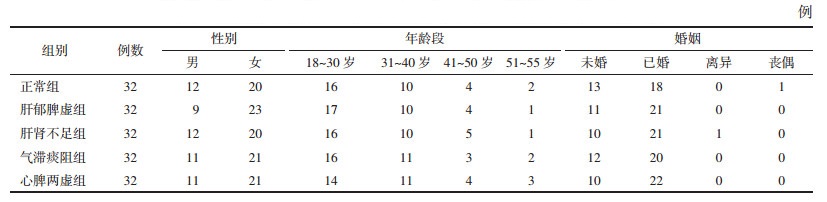
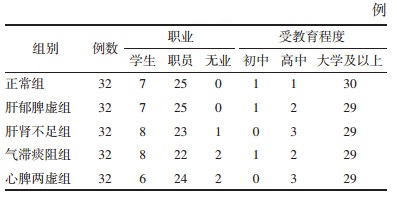
3.1 基线分析对肝郁脾虚组、肝肾不足组、气滞痰阻组、心脾两虚组以及正常组受试者的性别、年龄、年龄段、婚姻、职业和受教育程度进行比较,差异无统计学意义(P>0.05),基线资料满足均衡性要求,具有可比性。见表 1-3。
|
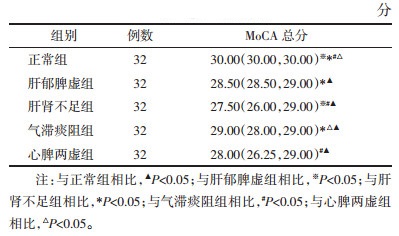
CFS各主要中医证型组的MoCA总分均低于正常组(P<0.05)。各主要中医证型组间比较,肝肾不足组MoCA总分低于肝郁脾虚组和气滞痰阻组,心脾两虚组MoCA总分低于气滞痰阻组(P<0.05)。见表 4。
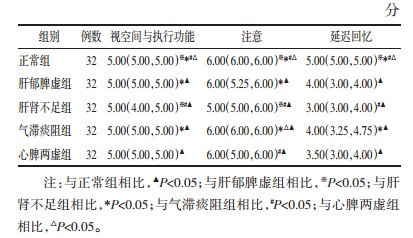
CFS各主要中医证型组的视空间与执行功能、注意、延迟回忆模块分均低于正常组(P<0.05)。各主要中医证型组间比较,肝肾不足组视空间与执行功能模块分低于肝郁脾虚组和气滞痰阻组(P<0.05);肝肾不足组注意模块分低于肝郁脾虚组和气滞痰阻组,心脾两虚组注意模块分低于气滞痰阻组(P<0.05);肝肾不足组延迟回忆模块分低于气滞痰阻组(P<0.05)。见表 5。
|
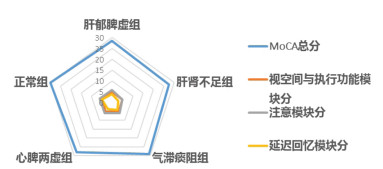
将CFS各主要中医证型组MoCA总分、视空间与执行功能模块分、注意模块分以及延迟回忆模块分制作成雷达图进行总体评价,发现CFS各主要中医证型患者的相应认知域均存在异常。与气滞痰阻组、肝郁脾虚组相比,肝肾不足组、心脾两虚组的认知情况更差。见图 1。
|
| 图 1 各主要中医证型MoCA总分、视空间与执行功能、注意、延迟回忆模块分中位数雷达图 Fig. 1 Median radar graph of MoCA total scores, module scores of visual space and executive function, attention and delayed recall of major TCM syndrome group |
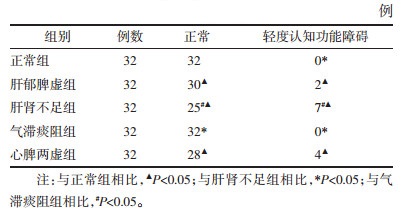
对MoCA总分进行分层分析发现,肝肾不足组CFS中轻度认知功能障碍(MCI)有7例,提示CFS各主要中医证型中肝肾不足证者出现MCI的可能性更大。见表 6。
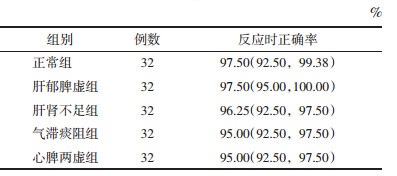
CFS各主要中医证型组与正常组相比,B反应时(BRT)正确率差异无统计学意义(P>0.05)。见表 7。CFS各主要中医证型组BRT较正常组均有延长(P<0.05);各主要中医证型组间比较,肝肾不足组、心脾两虚组BRT长于气滞痰阻组(P<0.05);而肝肾不足组与心脾两虚组相比,肝郁脾虚组与肝肾不足组、心脾两虚、气滞痰阻组相比,差异无统计学意义(P>0.05)。见表 8。
|
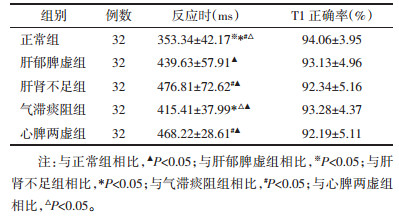
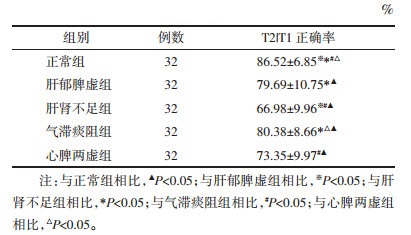
T1正确率:各组间比较,差异无统计学意义(P>0.05),见表 8。T2|T1正确率:CFS各主要中医证型组T2|T1正确率均低于正常组(P<0.05)。各主要中医证型组间比较,肝肾不足组T2|T1正确率低于肝郁脾虚组和气滞痰阻组,心脾两虚组T2|T1正确率低于气滞痰阻组(P<0.05)。见表 9。
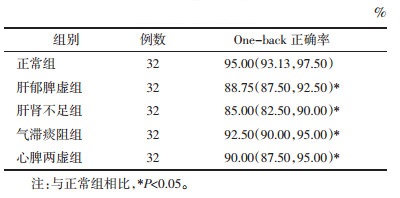
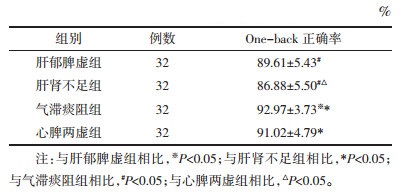
CFS各主要中医证型组One-back正确率均较正常组下降(P<0.05),见表 10。各主要中医证型组间比较,肝肾不足组One-back正确率低于气滞痰阻组和心脾两虚组,肝郁脾虚组One-back正确率低于气滞痰阻组(P<0.05)。见表 11。
|
|
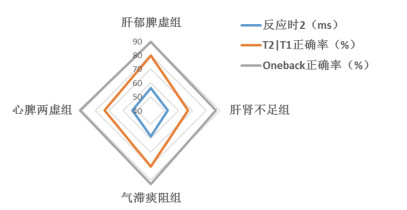
将CFS各主要中医证型组的反应时2(ms)(反应时2=100-反应时/10)、T2|T1正确率(%)以及One-back正确率(%)平均值制成雷达图进行总体评价,发现肝肾不足组、心脾两虚组在BRT、RSVP中成绩较气滞痰阻组和肝郁脾虚组更差。One-back测试中,肝肾不足组成绩最差,气滞痰阻组较好。见图 2。
|
| 图 2 各主要中医证型组反应时2、T2|T1正确率以及One-back正确率平均值雷达图 Fig. 2 Average value radar graph of reaction time 2 accuracy, T2|T1 accuracy and One-back accuracy in each major TCM syndrome groups |
根据认知心理学试验结果发现,肝肾不足组和心脾两虚组患者的信息处理速度、注意的保持和分配功能受损较为严重,气滞痰阻组和肝郁脾虚组患者上述功能受损相对较轻。同时,肝肾不足组在记忆刷新功能方面受损情况最重,气滞痰阻组受损情况最轻。
4 讨论CFS与中医“郁病”“不寐”等病证类似,若疾病迁延、脏腑亏损,可发展为“虚劳”。从中医病因病机角度分析,CFS与感受六淫、情志所伤、脏腑功能紊乱有关,由多脏腑气血阴阳失调所致。气滞、气虚为基础病机,气虚可继发气血阴阳之不足,气滞可进一步导致“火”“痰”“血”之郁结,往往虚实夹杂为患[7]。就五脏而言,CFS的发生与肝、脾、肾、心关系密切,与脏腑气机失调有关,形成夹郁、夹瘀、夹湿等本虚标实之象[8]。
课题组前期研究发现,部分CFS患者存在轻度认知功能障碍(MCI),并且在CFS诸多非特异性的症状表现中,短期内的记忆力减退(记忆障碍)、注意力不集中(注意障碍)是CFS患者普遍存在的主观体验[9]。与躯体症状相比,认知心理症状对患者的社交和工作产生更为严重的影响[10]。
本研究认识心理学评估阶段,BRT用于评价受试者的信息加工速度,反映其选择和判断的心理过程[11]。RSVP用于评价注意的保持和分配功能[12],当不同类型刺激在一定间隔内(200~500 ms)出现在同一位置时,往往T2的正确率显著低于T1的正确率,被称为“注意瞬脱现象”(AB),该现象与心理不应期密切相关,且与资源有限性相关。另有“推动反弹理论”(BB)则认为,T1出现后兴奋反应环路激活并推动目标刺激的感知觉加工过程,而紧随T1出现的分心刺激进入工作记忆后,系统将其识别为错误信息继而激活抑制反应环路,引发强烈的反弹效应,故使分心刺激后出现的目标刺激得不到识别。One-back任务则用于评价执行功能中的记忆刷新功能。本研究结果表明,在确保正确率的前提下,CFS患者需耗费更多时间进行选择和判断,从而导致信息加工的速度下降。主要中医证型CFS患者“注意瞬脱现象”较正常组更明显,结合相关理论[13]推测,该现象出现的原因可能为CFS患者工作记忆容量下降,或对分心刺激的过多注意而加剧了反弹效应。此外,主要中医证型CFS患者的记忆刷新功能也存在异常。在One-back测试中,CFS患者正确率低于正常组,且随着测试进行,有患者主诉出现短暂的大脑空白,提示CFS患者可能存在工作记忆保持的异常。这种现象可能是躯体、认知和心理的共同作用所造成的[14]。
中医理论认为,五脏为五神之舍,“心藏神”“肝藏魂”“脾藏意”“肺藏魄”“肾藏志”。本研究中,BRT涉及知觉、思维和反应等心理过程,与中医学的心、思、智密切相关,即与心、脾、肾等脏腑功能有关。RSVP过程所涉及心理活动包括知觉、注意、记忆等,与中医学的意相关,即与心、脾密切相关。One-back测试则涉及知觉、记忆、思维和反应等心理过程,与中医学的心、忆、意、智相关,即与心、脾、肾脏腑有关。结合相关中医理论,心脾两虚组应当在认知心理测试中成绩较差,研究结果与之相符。CFS者长期劳倦或思虑,导致心神耗伤、脾气亏虚。此外,本研究结果提示,肝肾不足证CFS患者出现MCI例数最多。中医理论认为,肾所主“志”与反映和判断相关。若肾精亏损,则神无所归;若阴血不生,则脑神失养。《黄帝内经》提出肝肾同源论,“人始生,先成精,精成而脑髓生”,“肾生骨髓,髓生肝”。因而临床肝肾不足并见之CFS患者往往因精血乏源、髓海失养,出现认知障碍的表现,与研究结果肝肾不足组在认知心理测试中表现较差相符。
综上,临床防治CFS患者认知功能受损可重点关注肝肾不足与心脾两虚证型,早期实施中医药干预或可延缓MCI进程。
| [1] |
HOLMES G P, KAPHN J E, GANTZ N M, et al. Chronic fatigue syndrome:a working case definition[J]. Annals of Internal Medicine, 1988, 108(3): 387-389. DOI:10.7326/0003-4819-108-3-387 |
| [2] |
陈敏, 张振贤, 周展红, 等. 慢性疲劳综合征与抑郁症、焦虑症患者临床症状的差异[J]. 中国康复理论与实践, 2014, 20(6): 576-579. CHEN M, ZHANG Z X, ZHOU Z H, et al. Differences of clinical symptoms among chronic fatigue syndrome, depression or anxiety[J]. Chinese Journal of Rehabilitation Theory and Practice, 2014, 20(6): 576-579. DOI:10.3969/j.issn.1006-9771.2014.06.017 |
| [3] |
彭敏, 马宏博, 司国民. 慢性疲劳综合征中医证候及证素特点的文献评析[J]. 中国中西医结合杂志, 2014, 34(6): 691-693. PENG M, MA H B, SI G M. A literature review on Chinese medicine syndrome and syndrome elements of chronic fatigue syndrome[J]. Chinese Journal of Integrated Traditional and Western Medicine, 2014, 34(6): 691-693. |
| [4] |
郑筱萸. 中药新药临床研究指导原则[M]. 北京: 中国医药科技出版社, 2002: 364. ZHENG X Y. Guiding principles for clinical research of new Chinese medicines[M]. Beijing: China Medical Science Press, 2002: 364. |
| [5] |
郭起浩, 洪震. 神经心理评估[M]. 上海: 上海科学技术出版社, 2016: 73. GUO Q H, HONG Z. Neuropsychological assessment[M]. Shanghai: Shanghai Scientific & Technical Publishers, 2016: 73. |
| [6] |
CHUN M M, POTTER M C. A two-stage model for multiple target detection; in rapid serial visual presentation[J]. Journal/Experiment Psychology-Human Perception and Performance, 1995, 21(1): 109-127. DOI:10.1037/0096-1523.21.1.109 |
| [7] |
吴梓堇, 张振贤. 张振贤治疗慢性疲劳综合征临床思路[J]. 中国中医药现代远程教育, 2018, 16(7): 69-71. WU Z J, ZHANG Z X. Clinical thought of Professor ZHANG Zhenxian in treating chronic fatigue syndrome[J]. Chinese Medicine Modern Distance Education of China, 2018, 16(7): 69-71. DOI:10.3969/j.issn.1672-2779.2018.07.028 |
| [8] |
吴整军, 钱妍, 仝战旗, 等. 慢性疲劳综合征中医证候特点述评[J]. 中医临床研究, 2016, 8(7): 144-145. WU Z J, QIAN Y, TONG Z Q, et al. An analysis of the characteristics of traditional Chinese medicine syndrome of chronic fatigue syndrome[J]. Clinical Journal of Chinese Medicine, 2016, 8(7): 144-145. DOI:10.3969/j.issn.1674-7860.2016.07.080 |
| [9] |
MCBRIDE R L, HORSFIELD S, SANDLER C X, et al. Cognitive remediation training improves performance in patients with chronic fatigue syndrome[J]. Psychiatry Research, 2017, 257: 400-405. DOI:10.1016/j.psychres.2017.08.035 |
| [10] |
CVEJIC E, LLOYD A R, VOLLMER-CONNA U. Neurocognitive improvements after best-practice intervention for chronic fatigue syndrome:preliminary evidence of divergence between objective indices and subjective perceptions[J]. Comprehensive Psychiatry, 2016, 66: 166-175. DOI:10.1016/j.comppsych.2016.02.002 |
| [11] |
OCON A J. Caught in the thickness of brain fog:exploring the cognitive symptoms of chronic fatigue syndrome[J]. Frontiers in Physiology, 2013, 4: 63. |
| [12] |
LINDE N, SANNE L, GIJ S, et al. The impact of chronic fatigue syndrome on cognitive functioning in adolescents[J]. European Journal of Pediatrics, 2016, 175(2): 245-252. DOI:10.1007/s00431-015-2626-1 |
| [13] |
COCKSHELL S J, MATHIAS J L. Test effort in persons with chronic fatigue syndrome when assessed using the validity indicator profile[J]. Journal of Clinical and Experimental Neuropsychology, 2012, 34(7): 679-687. DOI:10.1080/13803395.2012.668176 |
| [14] |
ICKMANS K, MEEUSM, KOS D, et al. Cognitive performance is of clinical importance, but is unrelated to pain severity in women with chronic fatigue syndrome[J]. Clinical Rheumatology, 2013, 32(10): 1475-1485. DOI:10.1007/s10067-013-2308-1 |