 2022, Vol. 39
文章信息
- 王文慧, 薛炳鹤, 张子扬, 王洪峰
- WANG Wenhui, XUE Binghe, ZHANG Ziyang, WANG Hongfeng
- 基于磁共振成像技术针灸相关文献计量学分析
- Bibliometric analysis of acupunctur-related literature based on magnetic resonance imaging techniques
- 天津中医药, 2022, 39(12): 1547-1553
- Tianjin Journal of Traditional Chinese Medicine, 2022, 39(12): 1547-1553
- http://dx.doi.org/10.11656/j.issn.1672-1519.2022.12.08
-
文章历史
- 收稿日期: 2022-10-28


2. 福建中医药大学附属泉州市正骨医院疼痛科, 泉州 362000;
3. 长春中医药大学, 长春 130117
针灸作为传统的中医疗法,在国际上认可度高,应用广泛[1-2]。然而,针灸作用的具体机制目前尚不明确。近年来,神经影像技术打开了研究针灸作用机制的新思路。其中磁共振成像(MRI),由于其无创性、可视性、优秀的空间分辨率等,被广泛用于临床疾病诊断及科研探索中[3-6]。随着一篇基于MRI技术的针刺对脑功能反应研究的文献发表,引发了学者们对基于MRI技术的针灸研究的关注[7-8]。文献计量分析,用于评估分析文献基本信息,已在许多领域得到应用。通过分析发文量、机构、期刊、关键词等,可以反映该领域研究趋势和热点[9]。因此,本研究欲通过分析国内外该领域文献基本信息,明确基于MRI技术的针灸研究的现状,以期为今后的研究提供参考。
1 资料与方法 1.1 文献来源国内期刊选择中国知网(CNKI)、维普数据库(VIP)、万方全文数据库(Wanfang Data),国外期刊选择Web of science数据库。
1.2 文献检索检索范围建库至2022年6月,中文检索词:1)磁共振成像。2)针灸、针刺、电针、艾灸、灸。英文检索词:1)MRI、magnetic resonance imaging。2)Acupunct*,moxibust*,构建检索式1)和2)。
1.3 文献筛选检索出的文献去除重复发表的,去除综述、系统评价类文章,剔除与检索主题不符的。
1.4 数据分析文献经Note Express整合后,导入Excel内进行数据统计分析,统计文献的发表年度、期刊、作者、作者单位、关键词、被引频次等。
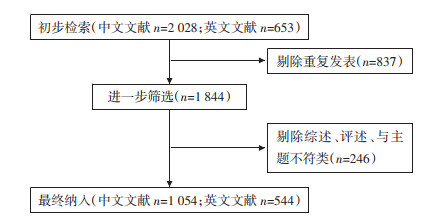
2 结果 2.1 文献检索情况中文数据库初步检索得到2 028篇文献,英文数据库得到文献653篇,按照上述筛选标准最终得到中文文献1 054篇,英文文献544篇。见图 1
|
| 图 1 磁共振成像相关的针灸领域中英文文献筛选流程 Fig. 1 Screening process of Chinese and English literature in the acupuncture field related to MRI |
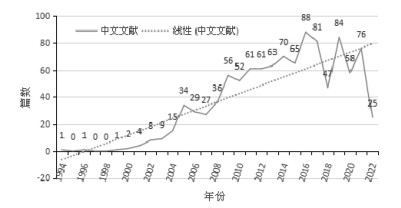
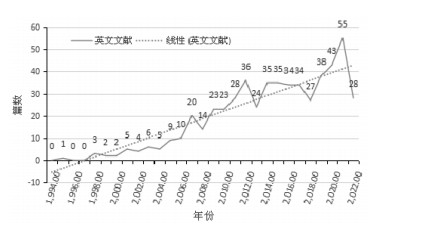
建库至2022年6月,针灸领域应用磁共振成像技术相关的中英文文献数量总体呈增长趋势。中文文献在2005年迎来了第1个高峰,年发表量34篇。英文文献的第1个高峰在2007年发表了20篇文献。此后中英文文献均出现短暂下滑,并分别在2016(88篇)、2021年(55篇)达到高峰。由于2022年是部分数据,因此不能代表该年度发文量。见图 2、3。
|
| 图 2 磁共振成像相关的针灸领域中文发文量情况 Fig. 2 Number of Chinese literature published in the acupuncture field related to MRI |
|
| 图 3 磁共振成像相关的针灸领域英文发文量情况 Fig. 3 Number of English literature published in the acupuncture field related to MRI |
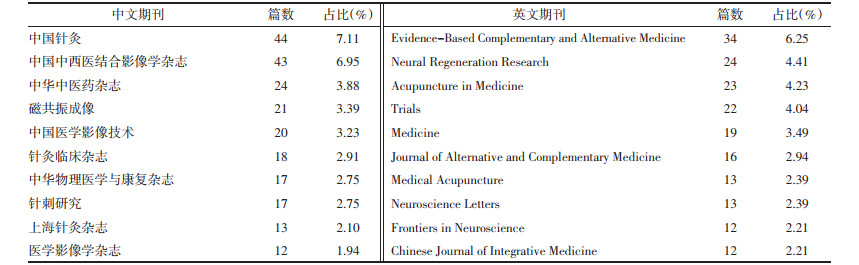
中文期刊文献619篇发表在239种期刊上,发表数量前10的期刊中核心期刊有7种,发文量占中文期刊文献总量的25.21%。其中以《中国针灸》发文量最高,发表44篇,占中文期刊文献总量的7.11%。英文期刊文献544篇发表在197种期刊上,发表数量前10的期刊中影响因子≥3分的期刊有2种,分别为《神经科学前沿》(Frontiers in Neuroscience)与《神经科学通讯》(Neuroscience Letters),占英文文献总量的5.6%。以补充替代医学证据(Evidence-Based Complementary and Alternative Medicine)发文量最高,发表34篇,占英文期刊文献总量的6.25%。见表 1。
|
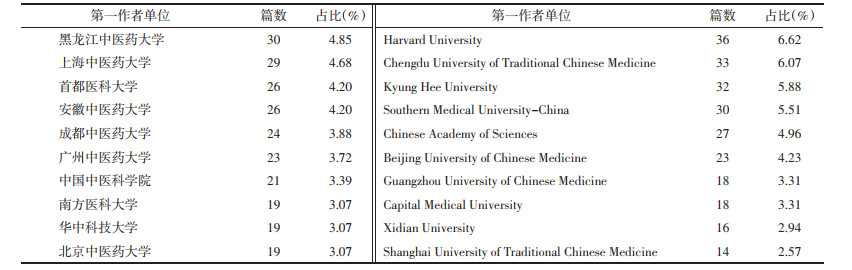
本研究以第一作者的单位为分析对象,分析发现中文期刊文献分布在63家单位,发文量排名前10的单位中,7家为中医药类大学,占中文期刊文献总量的27.79%。其中,黑龙江中医药大学和上海中医药大学分别位居第1、2名,各占中文期刊文献总量的4.85%、4.68%。英文期刊文献分布在156个不同单位,发文量排名前10的单位中中国有8家单位,占英文期刊文献总量的32.9%,其中中医药类大学有4家占英文期刊总量的16.18%。除中国单位外,其他两家分别为排名第1的美国哈佛大学和排名第3的韩国庆熙大学,分别占比6.62%、5.88%。见表 2。
|
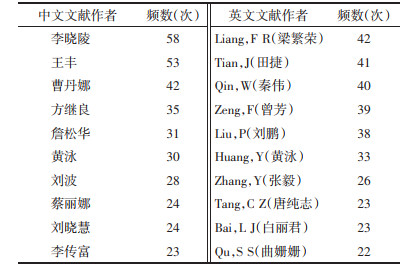
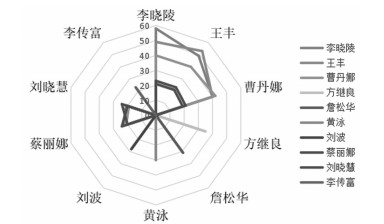
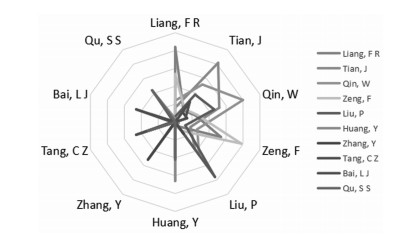
分析发文频次前10位的作者,发文量皆在20篇以上。其中中文文献排在第一位的为李晓陵58次,合作关系最密切的是李晓陵、曹丹娜、王丰、蔡丽娜、刘晓慧。英文文献排在第一位的为梁繁荣42次,合作关系最密切的是梁繁荣(Liang,F R)、田捷(Tian,J)、秦伟(Qin,W)、曾芳(Zeng,F)、刘鹏(Liu,P)。见表 3,图 4、5。
|
|
| 图 4 磁共振成像相关的针灸领域中文文献作者发文频次(频数≥20次) Fig. 4 Frequency of publication by Chinese literature authors in the field of acupuncture related to MRI (frequency≥20) |
|
| 图 5 磁共振成像相关的针灸领域英文文献作者发文频次(频数≥20次) Fig. 5 Frequency of publication by English literature authors in the field of acupuncture related to MRI (frequency≥20) |
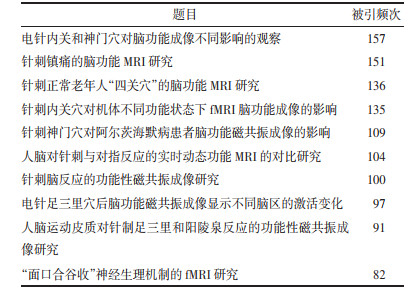
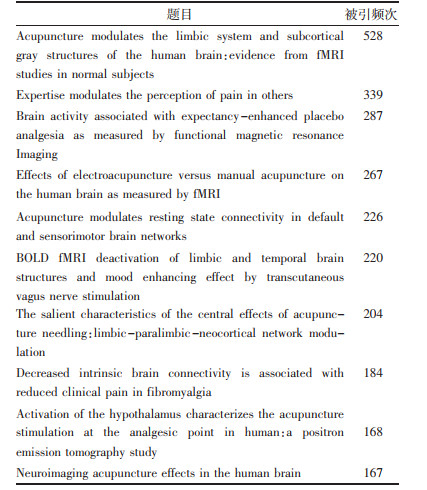
分析被引用频次前10位的中英文文献,可见中文文献7篇为穴位相关,以针刺不同穴位不同脑区功能影像的变化为主,涉及内关、神门、四关、足三里、阳陵泉、合谷等穴位;其中被引频次最高的为付平等的“电针内关和神门穴对脑功能成像不同影响的观察”157次,其次为侯金文等的“针刺镇痛的脑功能MRI研究”151次;针刺干预的疾病或症状主要为疼痛和阿尔兹海默病。英文文献中有4篇高被引文献为疼痛相关,3篇为针刺激活不同脑区的影像观察;其中被引频次最高的为“针灸调节人大脑的边缘系统和皮层下灰色结构:来自正常受试者的功能磁共振成像研究的证据”528次,其次为“专业知识调节他人对疼痛的感知”339次;针刺干预的疾病或症状主要为疼痛。见表 4、5。
|
|
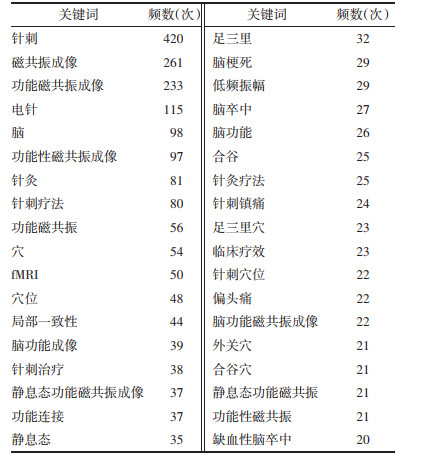
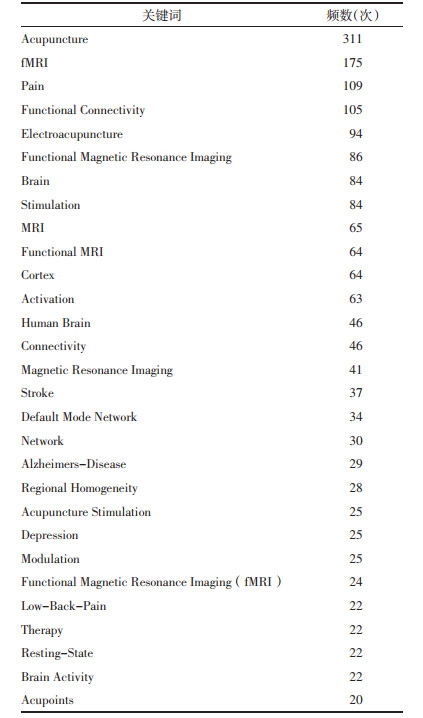
中文关键词共1 901个,英文关键词共2 687个。分别选取频数≥20次的关键词,可见中文关键词有36个,以针刺、磁共振成像、电针、脑、针灸、穴为主,其次为局部一致性、静息态功能磁共振成像、功能连接、足三里、脑梗死、低频振幅、脑卒中、脑功能、合谷、针刺镇痛等。英文关键词有29个,以针刺、功能磁共振、疼痛、电针、脑、刺激为主,其次为中风、默认模式网络、阿尔兹海默症、局部一致性、抑郁、腰痛、穴位等。高频关键词在一定程度上反应了该领域的研究热点[10],因此推测上述可能为目前国内外的研究热点。见表 6、7。
|
|
大量研究证明MRI技术为针灸效应的作用机制提供了可视化证据[11-14],本文基于此对相关文献进行分析。发现自建库以来国内外发文趋势总体呈波动性增长,在2005年开始增长明显,并分别在2016年、2021年到达发文量高峰。说明近些年人们对应用MRI技术研究针灸作用原理越发关注。
从期刊分布来看,中英文文献总体分布较分散。发文量排名前10的中文期刊里核心期刊7种,占中文期刊文献总量的25.21%,说明基于MRI探究针灸原理在国内认可度较高。然而国外高质量期刊数量较少,同样在发文量排名前10的英文期刊里,只有《神经科学前沿》(Frontiers in Neuroscience)与《神经科学通讯》(Neuroscience Letters)影响因子在3分以上,仅占英文文献总量的5.6%,其余影响因子皆小于3分。这说明目前国际上仍缺乏关于MRI技术探究针灸原理的高质量文献。
分析发文单位及作者,可以看到中文发文量排名前10的单位,大部分为中医药类高校,发文量占中文期刊文献总发文量的27.79%,而只有3家为西医类院校和综合高校,可能由于针灸属于中医学的二级学科,所以中医药类高校为研究针灸的主战场。英文文献发文量前10名的单位中中国占8家,其次为美国哈佛大学和韩国庆熙大学,说明中国研究者具有一定的国际影响力。而与中文文献发文单位类别趋势不同的是,发现英文文献发文量前10名的发文单位里以西医类和综合类高校明显增多,发文量占英文文献总发文量的29.22%,中医类高校发文量只占英文文献总发文量的16.18%。这种现象说明多学科交叉在国际上更加受青睐,这从核心作者的分析也得到证实,国际发文量较高的作者中以成都中医药梁繁荣、中国科学院田捷、西安电子科技大学秦伟等合作最密切,说明交叉学科的重要性。
被引用频次一定程度上反应学术论文的影响力[15]。本文研究发现被引频次排名前10的中英文文献被引频次最高分别为157次、528次,最低分别为82次、167次,从影响力上来看英文文献总体高于中文文献。说明中文文献质量有待提升。中文高被引文章的研究内容多与穴位相关,涉及到的穴位内关、神门、四关、足三里、阳陵泉、合谷等,与临床治疗中枢神经系统疾病常用穴位相似[16-18],反映出应用MRI技术探究针灸原理多集中于中枢机制的研究。英文高被引文章研究内容不同于中文,没有集中于研究不同穴位的差异性。这可能跟国际上在针刺作用原理研究上一直致力于穴位与非穴位的差异有关[19],同样也说明中医传统的穴位理论在国际上的普及度低。但可以看到无论是国内还是国外,“疼痛”都是研究主流方向。这同样在关键词上也有所体现,分析中英文高频关键词发现,中文文献涉及到的疾病、症状以脑梗死、脑卒中、镇痛、偏头痛为主。英文文献涉及疾病、症状除疼痛外,还有中风、阿尔兹海默症、抑郁等。再次说明MRI技术主要用于探究针灸治疗中枢神经系统疾病的作用原理。但临床针刺的应用不仅限于脑部疾病,对治疗关节类、脏器类疾病亦有明显的临床疗效,MRI技术也常被用于这些疾病的观察、诊断[20]。因此,今后研究者不仅要提高目前的研究热点所发表文献质量,还需要扩大研究范围。用MRI技术使针灸原理更加清晰化,从而更好的指导针灸临床实践。
本文尚有几点不足之处,本文的检索词、数据库可能不够全面,且未对检索到的文献做深入分析,因此基于此的分析有一定局限性。希望今后的研究扩大数据来源,多角度深入分析文献信息,规范统计结果,以保证研究结果的全面性和可靠性。
| [1] |
LI C C, GABRIEL S B, LUIS U, et al. The evolving conception and practice of acupuncture-moxibustion[J]. Journal of Acupuncture and Tuina Science, 2018, 16(6): 370-374. DOI:10.1007/s11726-018-1065-8 |
| [2] |
谢瑞, 闫钰, 高文雅, 等. 欧洲五国中医药认知度调查与中医药教育现状探究[J]. 世界中西医结合杂志, 2020, 15(1): 183-188. XIE R, YAN Y, GAO W Y, et al. Recognition and education of traditional Chinese medicine in five European countries: a survey[J]. World Journal of Integrated Traditional and Western Medicine, 2020, 15(1): 183-188. |
| [3] |
贾静, 孙燕, 马重兵, 等. 基于静息态功能磁共振成像低频振幅算法探讨针刺治疗儿童屈光参差性弱视的机制[J]. 中华中医药杂志, 2022, 37(5): 2734-2739. JIA J, SUN Y, MA C B, et al. Mechanism of acupuncture in the treatment of children with anisometropic amblyopia based on amplitude of low frequency fluctuation analysis by rs-fMRI[J]. China Journal of Traditional Chinese Medicine and Pharmacy, 2022, 37(5): 2734-2739. |
| [4] |
庄紫晗, 樊小农, 王舒, 等. 功能磁共振成像在针刺治疗中风后吞咽障碍机制研究中应用[J]. 上海针灸杂志, 2022, 41(3): 313-317. ZHUANG Z H, FAN X N, WANG S, et al. fMRI in studying the mechanism of swallowing disorders after stroke[J]. Shanghai Journal of Acupuncture and Moxibustion, 2022, 41(3): 313-317. |
| [5] |
蔡荣林, 管媛媛, 武红利, 等. 胃俞募配穴针刺对胃扩张状态下受试者静息态脑功能磁共振成像后扣带回功能连接的影响[J]. 中华中医药杂志, 2020, 35(8): 4230-4234. CAI R L, GUAN Y Y, WU H L, et al. Effects on the posterior cingulate cortex functional connectivity of resting-state brain function in the healthy subjects of gastric distention treated with acupuncture at the front-mu and back-Shu points of the stomach[J]. China Journal of Traditional Chinese Medicine and Pharmacy, 2020, 35(8): 4230-4234. |
| [6] |
李晓陵, 蔡丽娜, 王丰, 等. "足缓难行刺冲阳"脑效应机制功能磁共振成像研究[J]. 磁共振成像, 2018, 9(11): 831-835. LI X L, CAI L N, WANG F, et al. Functional magnetic resonance imaging study of brain effect mechanism of "acupuncture at Chongyang acupoint for the treatment of walking slowly and difficulty"[J]. Chinese Journal of Magnetic Resonance Imaging, 2018, 9(11): 831-835. |
| [7] |
YOSHIDA T, TANAKA C, UMEDA M, et al. Non-invasive measurement of brain activity using functional MRI: toward the study of brain response to acupuncture stimulation[J]. The American Journal of Chinese Medicine, 1995, 23(3/4): 319-325. |
| [8] |
SUN R R, YANG Y, LI Z J, et al. Connectomics: a new direction in research to understand the mechanism of acupuncture[J]. Evidence-Based Complementary and Alternative Medicine: ECAM, 2014, 2014(11): 568429. |
| [9] |
万昊, 谭宗颖, 朱相丽. 同行评议与文献计量在科研评价中的作用分析比较[J]. 图书情报工作, 2017, 61(1): 134-152. WAN H, TAN Z Y, ZHU X L. Comparison of the role of peer review and bibliometrics in research evaluation[J]. Library and Information Service, 2017, 61(1): 134-152. |
| [10] |
朱宏. 基于知识图谱的我国高等教育研究进展可视化分析: 以《高等教育研究》1999-2012年刊发论文为样本[D]. 兰州: 西北师范大学, 2014. ZHU H. Visualization research on Chinese higher education progress sharing from the perspective of mapping knowledge-In 1999-2012 annual publication of the paper higher education as a sample[D]. Lanzhou: Northwest Normal University, 2014. |
| [11] |
HUI K K, LIU J, MAKRIS N, et al. Acupuncture modulates the limbic system and subcortical gray structures of the human brain: evidence from fMRI studies in normal subjects[J]. Human Brain Mapping, 2000, 9(1): 13-25. |
| [12] |
张贵锋, 黄泳, 唐纯志, 等. 针刺外关穴得气对脑中枢激活与负激活的比较研究[J]. 中华中医药学刊, 2017, 35(2): 269-272, 513. ZHANG G F, HUANG Y, TANG C Z, et al. Comparison of activation and deactivation on central brain when deqi by needing waiguan(SJ5)[J]. Chinese Archives of Traditional Chinese Medicine, 2017, 35(2): 269-272, 513. |
| [13] |
边文瑾, 甄俊平, 靳波, 等. 脑功能成像对针刺足阳明胃经中枢镇痛机制的初步探讨[J]. 磁共振成像, 2020, 11(11): 979-984. BIAN W J, ZHEN J P, JIN B, et al. A preliminary study on the central analgesic mechanism of acupuncturing the stomach meridian foot-Yangming by fMRI[J]. Chinese Journal of Magnetic Resonance Imaging, 2020, 11(11): 979-984. |
| [14] |
方继良, 荣培晶, 刘波. 现代脑功能磁共振诠释传统针刺机制[J]. 磁共振成像, 2020, 11(2): 81-83. FANG J L, RONG P J, LIU B. Modern fMRI exploring the neuromechanism of traditional acupuncture[J]. Chinese Journal of Magnetic Resonance Imaging, 2020, 11(2): 81-83. |
| [15] |
FARDI A, KODONAS K, GOGOS C, et al. Top-cited articles in endodontic journals[J]. Journal of Endodontics, 2011, 37(9): 1183-1190. |
| [16] |
解鸿宇, 袁爱红, 潘宾, 等. 基于扶阳思想探析针灸治疗中风后认知功能障碍选穴规律[J]. 河南中医, 2022, 42(5): 740-747. XIE H Y, YUAN A H, PAN B, et al. An analysis of acupoint selection law of acupuncture and moxibustion in the treatment of cognitive impairment after stroke based on the thought of reinforcing yang[J]. Henan Traditional Chinese Medicine, 2022, 42(5): 740-747. |
| [17] |
赵利华, 陈树燕, 陈尚杰, 等. 运用数据挖掘技术分析针灸治疗轻度认知功能障碍的选穴规律[J]. 中国老年学杂志, 2018, 38(16): 3930-3934. ZHAO L H, CHEN S Y, CHEN S J, et al. The point selection rule of acupuncture in the treatment of mild cognitive dysfunction was analyzed by data mining technology[J]. Chinese Journal of Gerontology, 2018, 38(16): 3930-3934. |
| [18] |
刘爽, 张玉莲, 周震. 调神益智针刺法治疗轻度认知功能障碍疗效观察[J]. 上海针灸杂志, 2016, 35(11): 1278-1280. LIU S, ZHANG Y L, ZHOU Z. Observation on the therapeutic effect of Tiaoshen Yizhi acupuncture for mild cognitive impairment[J]. Shanghai Journal of Acupuncture and Moxibustion, 2016, 35(11): 1278-1280. |
| [19] |
VICKERS A J, CRONIN A M, MASCHINO A C, et al. Acupuncture for chronic pain: individual patient data meta-analysis[J]. Medical Acupuncture, 2012, 172(19): 1444-1453. |
| [20] |
贾润慧, 汪新柱, 陈晓飞, 等. 下腰痛患者针刺治疗脑功能网络的小世界拓扑特性[J]. 中国中西医结合影像学杂志, 2021, 19(1): 24-26. JIA R H, WANG X Z, CHEN X F, et al. Small-world topological characteristics of the brain functional networks in patients with low back pain which treated by acupuncture[J]. Chinese Imaging Journal of Integrated Traditional and Western Medicine, 2021, 19(1): 24-26. |
2. Department of Pain Management, Quanzhou Orthopedi-Traumatological Hospital of Fujian Traditional Chinese Medicine University, Quanzhou 362000, China;
3. Changchun University of Chinese Medicine, Changchun 130117, China