 2025, Vol. 42
文章信息
- 郑春龙, 段万石.
- ZHENG Chunlong, DUAN Wanshi.
- 鱼腥草素钠对小鼠急性肺损伤的保护作用及其对肠道菌群的影响
- Protective effects of sodium houttuyfonate on acute lung injury in mice and its impact on gut microbiota
- 天津中医药, 2025, 42(9): 1177-1183
- Tianjin Journal of Traditional Chinese Medicine, 2025, 42(9): 1177-1183
- http://dx.doi.org/10.11656/j.issn.1672-1519.2025.09.13
-
文章历史
- 收稿日期: 2025-04-26


急性肺损伤(ALI)是一种由多种致病因素引起的急性、弥漫性、炎症性肺损伤,其高发病率和病死率对公众健康构成了严重威胁[1-2]。目前,ALI主要的干预手段是机械通气,但该策略可能会导致呼吸机相关性肺损伤[3-4],患者的生活质量和病死率并没有显著改善。其他治疗方法,如皮质类固醇具有一些益处,但会带来许多毒副作用,包括皮肤萎缩、骨密度降低和胃肠不适[5]。由于尚无特异性药物治疗,ALI常进展为急性呼吸窘迫综合征,其病死率高达40%~60%[6]。因此,探索有效的保护性干预措施和防治策略具有重要意义。
《黄帝内经》有“肺与大肠相表里”之说,即肺与肠互相影响、互相依存[7]。最近的研究表明,肠道菌群可以通过“肠肺轴”影响ALI的肺功能[3, 8-10]。因此,改善肠道菌群结构可能成为防治ALI的重要途径。鱼腥草素钠(SH)具有包括抗菌和抗炎在内的多种生物活性,对肺组织有保护作用[11]。有报道称,SH可通过调节肠道微生物群来缓解肺部疾病[12-13]。然而,SH在调节ALI肠道微生物群及肺组织损伤中的作用仍不清楚。因此,本研究旨在探讨SH在体内对脂多糖(LPS)诱导的ALI小鼠肠道菌群的影响及可能机制。
1 材料与方法 1.1 主要材料及试剂SH(K196584,纯度≥98%)购自西安开来生物工程有限公司。LPS(大肠杆菌055:B5,L118716)购自上海阿拉丁生化科技有限公司。4%多聚甲醛固定液(BL539A)购自北京莱博科技有限公司。苏木精-伊红(HE)染色液(BA4097-500 mL)购自珠海贝索生物技术有限公司。肿瘤坏死因子-α(TNF-α,JL10484)、白细胞介素-6(IL-6,JL20268)、白细胞介素-1β(IL-1β,JL18442)和髓过氧化物酶(MPO,JL10367)酶联免疫吸附(ELISA)试剂盒购自上海江莱生物科技有限公司。一抗c-Jun氨基末端激酶(JNK)、磷酸化JNK(p-JNK)、丝裂原活化蛋白激酶(P38)和p-P38购自美国CST公司。二辛可宁酸(BCA)蛋白分析试剂盒、十二烷基硫酸钠聚丙烯酰胺凝胶电泳(SDS-PAGE)、辣根过氧化物酶(HRP)标记的二抗、增强的化学发光试剂盒购自碧云天生物技术公司。
1.2 动物模型的建立和分组18只SPF级雄性BALB/c小鼠,6~8周龄,体质量18~22 g,来自斯贝福生物技术有限公司[许可证号:SCXK(京)2019-0010]。小鼠饲养在标准实验室条件下,保持12 h光照/黑暗循环,温度为(25±1)℃,湿度为60%±5%,可自由饮水和进食。动物研究严格遵守实验动物护理和使用指南,并获得伦理委员会的批准(批号:wydw2023-0323)。适应1周后,将小鼠随机分为3组:对照组、模型组(LPS组)和SH组(LPS+SH 100 mg/kg),每组6只。SH组灌胃SH(100 mg/kg)[13],对照组和LPS组灌胃等体积生理盐水,每日1次,连续7 d。末次给药30 min后,除对照组外,其他组气管内注射LPS(5 mg/kg)溶液诱导ALI模型。对照组以生理盐水代替LPS[14]。LPS注射后24 h对小鼠实施安乐死,并采集肺组织和粪便样本。
1.3 实验方法 1.3.1 组织学检查将采集的肺右上叶在4% 多聚甲醛中固定过夜,脱水、石蜡包埋,切成5 μm厚的切片,并用HE染色液染色。使用光学显微镜(OLYMPUS BX51)观察图像。
1.3.2 肺湿质量/干质量(W/D)比的测量取小鼠右肺中叶,用磷酸缓冲盐溶液(PBS)冲洗,滤纸吸干表面多余水分,用精密电子天平称量肺组织,测定肺湿质量。然后将肺组织放入80 ℃干燥器中,充分干燥72 h,直至质量稳定。将干燥后的肺组织质量记录为肺干质量。最后计算肺湿质量/干质量(W/D)比值,以评估小鼠肺水肿程度。
1.3.3 肺组织匀浆中TNF-α、IL-1β、IL-6和MPO活性的测定按照制造商的说明,使用ELISA试剂盒测量肺组织中的TNF-α、IL-6、IL-1β和MPO水平。
1.3.4 蛋白免疫印迹(Western blot)分析取肺组织与RIPA裂解液混合,研磨10~15 min。样品在冰上搅拌30 min,然后收集上清液。用BCA蛋白分析试剂盒对蛋白质水平进行定量。然后,蛋白质样品经10%SDS-PAGE电泳分离蛋白条带。将蛋白质从凝胶中转移到聚偏氟乙烯膜上,用5%脱脂干奶封闭2 h。膜与一抗(1∶1 000)在4 ℃孵育过夜。在室温下与HRP标记的二抗(1∶1 000)孵育1 h后,用增强的化学发光试剂盒检测蛋白表达,并使用Image J软件进行半定量分析。
1.3.5 肠道菌群分析收集不同组别的粪便样本,用粪便DNA试剂盒(D5625-01,Omega Bio-Tek)提取每个粪便样本的总DNA。通过凝胶电泳检测所提取DNA的纯度和浓度,将DNA储存在-80 ℃下以备进一步分析。通过PCR扩增方法对样本DNA进行扩增,以富集细菌16S rDNA基因的V3-V4区。使用微孔板读数仪(FLx800,BioTek)和Agilent Bioanalyzer 2100系统(Agilent Technologies Inc.)对PCR产物进行定量。使用NovaSeq测序仪和NovaSeq 6000 SP试剂盒(500次循环)通过进行高通量测序。Chao指数反映物种丰富度,Shannon和Simpson指数反映样品内物种丰富度及均匀度,用于评估群体间的α多样性,使用基于非加权UniFrac距离的主坐标分析(PCoA)来评估β多样性,分析肠道菌群的聚类特征。
1.3.6 统计学方法使用GraphPad Prism软件8.0进行统计分析。正态分布的连续变量以均数±标准差(x ± s)表示,组间差异采用单因素方差分析(ANOVA)和Dunnett多重比较检验进行分析。非正态分布的连续变量以中位数(四分位数)表示,使用非参数检验Kruskal-Wallis和Dunn’s Test多重比较进行分析。进行Spearman相关性分析以探索炎症标志物与肠道菌群组成之间的关系。P < 0.05为差异具有统计学意义。
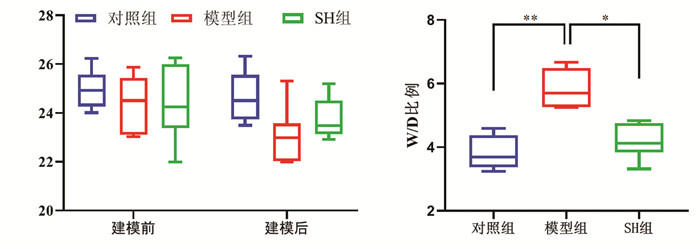
2 结果 2.1 SH对ALI小鼠肺组织的保护作用造模后各组小鼠均出现体质量下降,但各组小鼠体质量变化无差异(图 2A),各组小鼠均未出现死亡。肺组织水肿是ALI的主要特征,其表现为肺W/D比值增加。与对照组相比,模型组小鼠在LPS刺激后肺组织W/D比值明显升高(Z=-3.298,P=0.002),而SH可降低LPS诱导的ALI小鼠肺组织W/D比值(Z= -2.541,P=0.017)。见图 1B。
|
| 注:*P < 0.05,**P < 0.01。 图 1 SH对ALI小鼠(A)体质量及(B)肺组织湿干比(W/D)的影响(x ± s) Fig. 1 Effects of SH on(A) body weight and(B) lung wet-to-dry(W/D) ratio in ALI mice(x ± s) |

|
| 注:比例尺,100 μm。 图 2 各组小鼠HE染色肺切片的代表性图像 Fig. 2 Representative HE-stained lung tissue sections of mice from each experimental group |
接着探讨了每组小鼠的组织病理变化情况,见图 2。对照组肺组织结构完整,肺泡排列规则,未见组织病理学改变。与对照组相比,模型组肺泡和肺间质中可见大量炎症细胞浸润,伴有肺泡壁断裂、肺泡结构破坏及间质水肿,并可观察到局灶性肺泡出血及气道壁增厚。SH干预后,肺组织病变程度显著减轻,炎症细胞浸润明显减少,肺泡结构基本保持完整,间质水肿及出血情况明显改善。
2.2 SH对ALI小鼠炎症反应的影响模型组小鼠肺组织MPO活性较对照组明显升高(Z=-3.353,P=0.001),而SH可明显逆转LPS引起的这种变化(Z=-2.487,P=0.019)。LPS诱导肺组织中TNF-α(Z=-3.461,P=0.000 8)、IL-6(Z=-3.678,P=0.000 4)和IL-1β(Z=-3.244,P=0.001 8)的产生显著增加,而SH组降低了LPS诱导的肺组织中TNF-α(Z= -2.379,P=0.026)、IL-6(Z=-2.163,P=0.046)和IL-1β(Z=-2.271,P=0.035)的水平(P < 0.05)。见图 3。

|
| 注:*P < 0.05,**P < 0.01。 图 3 SH对ALI小鼠肺组织MPO、TNF-α、IL-6、IL-1β水平的影响(x ± s) Fig. 3 Effects of SH on MPO activity and TNF-α, IL-6, IL-1β levels in lung tissues of ALI mice(x ± s) |
模型组小鼠JNK/P38信号传导激活,p-JNK(Z=-3.708,P=0.000 3)和p-P38(Z=-3.569,P=0.000 5)蛋白表达显著升高,而SH抑制了JNK/P38信号传导(Z=-2.138,P=0.048;Z=-2.271,P=0.035)。见图 4。

|
| 注:图A为p-JNK/JNK蛋白表达水平;图B为p-P38/P38蛋白表达水平。*P < 0.05,**P < 0.01,***P < 0.001。 图 4 SH对ALI小鼠JNK信号通路的影响(x ± s) Fig. 4 Modulation of JNK signaling pathway by SH in ALI mice(x ± s) |
多样性指数分析显示,模型组肠道微生物组的α多样性显著低于对照组,即与对照组相比,模型组的Chao1、Shannon、Simpson和观察到的物种指数降低(Z=3.136,P=0.003;Z=3.244,P=0.002;Z=2.974,P=0.004;Z =2.866,P=0.006),SH组显著高于模型组(Z=2.541,P=0.017;Z=2.433,P=0.022;Z=2.866,P=0.006;Z =2.650,P=0.012)。见图 5A。PCoA图显示,3组的菌群组成明显分开,提示SH显著影响ALI小鼠的肠道菌群β多样性。见图 5B。

|
| 注:图A为Chao1、Simpson、Shannon和观察到的物种指数评估各组之间的α多样性;图B为基于未加权UniFrac距离的粪便微生物群主坐标分析(PCoA)评估各组β多样性。*P < 0.05,**P < 0.01。 图 5 SH对ALI小鼠肠道微生物群多样性的影响(x ± s) Fig. 5 Impact of SH on gut microbial diversity in ALI mice(x ± s) |
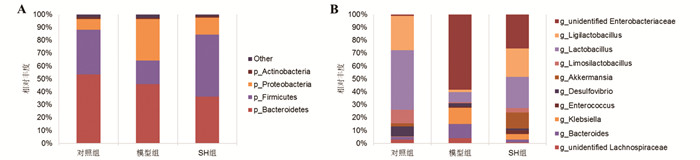
为了确定SH对肠道菌群的影响,研究比较了3组在门和属水平上的微生物分类群。在门水平上,与对照组相比,模型组Firmicutes的相对丰度降低,而Proteobacteria的相对丰度增加。与模型组相比,SH组Firmicutes的相对丰度升高,而Proteobacteria的相对丰度降低。见图 6A。在属水平上,与对照组相比,模型组unidentified_Enterobacteriaceae、Bacteroides和Klebsiella的相对丰度增加,而Ligilactobacillus、Lactobacillus和Akkermansia的丰度降低,而在SH组观察到了相反的趋势。见图 6B。
|
| 注:图A为肠道菌群门水平上的相对百分比,图B为肠道菌群属水平上的相对百分比。 图 6 SH对ALI小鼠肠道菌群组成的影响 Fig. 6 Alterations in gut microbiota composition induced by SH treatment in ALI mice |
此外,研究评估了肠道菌群与炎症指标及肺水肿之间的相关性,结果显示炎症指标及肺水肿与Proteobacteria、Klebsiella和g_unidentified_Enterobacteriaceae呈正相关(P < 0.05),与Akkermansia、Lactobacillus和Ligilactobacillus呈负相关(P < 0.05)。见图 7。

|
| 注:*P < 0.05,**P < 0.01,***P < 0.001。 图 7 肠道菌群与炎症指标及肺水肿之间的相关性 Fig. 7 Correlation analysis between gut microbiota and inflammatory markers/pulmonary edema |
LPS诱导的ALI是一种高度可重复的模型,能够反映临床病理生理学[15-16]。本研究通过LPS诱导建立ALI模型,证明了SH在保护ALI方面的有效性。肺水肿是ALI的一个典型症状,本研究使用肺W/D比来量化ALI的直接影响,结果发现SH可以显著减轻肺水肿,同时减少肺组织的炎症细胞浸润和肺组织的病理损伤,显著降低肺组织中IL-1β、IL-6和TNF-α的表达水平。这些变化与先前对ALI的改善研究一致[15, 17],这表明SH可以有效改善LPS诱导的ALI,但SH改善ALI的分子机制仍需进一步探讨。MAPKs家族包括c-Jun NH2末端激酶(JNK)和p38丝裂原活化蛋白激酶(p38 MAPK)可调节炎症和先天免疫[18-20]。通过抑制p38 /JNK通路可改善小鼠ALI并降低细胞因子表达[21]。本研究发现SH可以显著抑制P-p38 MAPK和P-JNK蛋白水平。这些结果表明SH减弱了LPS诱导的肺组织炎症反应,可能是通过抑制p38 MAPK/JNK信号通路实现的。
肺与大肠相通是中医重要理论之一,人体肠道菌群的稳定性显著影响肺部疾病的发展[7, 16]。大量研究支持肠道菌群通过传递肠肺轴激活与ALI的发生发展密切相关[3, 8-10]。本研究中,SH组肠道菌群丰富度较模型组有所升高,提示SH改善了ALI引起的肠道菌群失衡,调节肠道菌群的丰富度和多样性。在门水平上,生物体的肠道菌群以Bacteroidetes、Firmicutes、Proteobacteria和Actinobacteria为主[22],微生物群落对LPS诱导的ALI的反应主要趋势是Firmicutes的减少和Proteobacteria的增加[23]。Proteobacteria是一种革兰氏阴性需氧菌,被认为是肠道菌群失调的标志,也是LPS的重要来源,可诱发炎症并与多种慢性疾病有关[24]。SH降低了ALI小鼠肠道中Proteobacteria的丰富度,表明其具有减轻致病菌积累的潜力。SH还能改善肠道中属水平的菌群组成,可有效增加Ligilactobacillus、Lactobacillus和Akkermansia的丰度。相关性分析发现ALI小鼠肺部环境中的促炎介质IL-1β、TNF-α、IL-6及肺水肿与肠道菌群组成密切相关。
综上所述,SH对LPS诱导的小鼠ALI具有一定的保护作用,其潜在机制可能涉及通过抑制JNK/p38信号通路减轻炎症反应以及改善肠道菌群紊乱。然而,本研究存在一定局限性:首先,虽然观察到SH处理组JNK/p38通路相关蛋白磷酸化水平下降,但目前仅基于蛋白水平变化推测其作用机制,尚缺乏特异性抑制剂干预、基因敲除或过表达等进一步直接验证,因此推测SH可能通过JNK/p38信号通路发挥作用的证据尚显不足;其次,肠道菌群如何具体调节肺部炎症反应的机制尚未深入阐明。未来将通过更多机制性实验(如信号通路特异性抑制剂干预)进一步验证JNK/p38信号通路的作用,以及探讨肠道菌群在肺保护作用中的具体机制。
| [1] |
SHANG L, ZHANG M, LI J, et al. Dachengqi Decoction alleviates acute lung injury by suppressing HIF-1alpha-mediated glycolysis[J]. Journal of Ethnopharmacology, 2024, 321(3): 117410. |
| [2] |
ZHU Y, LUO L, ZHANG M, et al. Xuanfei Baidu Formula attenuates LPS-induced acute lung injury by inhibiting the NF-kappaB signaling pathway[J]. Journal of Ethnopharmacology, 2023, 301(1): 115833. |
| [3] |
LI R, YANG H, XUE Y, et al. Yemazhui ameliorates lipopolysaccharide-induced acute lung injury modulation of the toll-like receptor 4/nuclear factor kappa-B/nod-like receptor family pyrin domain-containing 3 protein signaling pathway and intestinal flora in rats[J]. Journal of Traditional Chinese Medicine, 2024, 44(2): 303-314. |
| [4] |
MOKRA D. Acute lung injury-from pathophysiology to treatment[J]. Physiological Research, 2020, 69(Suppl 3): S353-S366. |
| [5] |
MOKRA D, MIKOLKA P, KOSUTOVA P, et al. Corticosteroids in acute lung injury: The dilemma continues[J]. International Journal of Molecular Sciences, 2019, 20(19): 4765. DOI:10.3390/ijms20194765 |
| [6] |
REN Z, ZHENG Z, FENG X. Role of gut microbes in acute lung injury/acute respiratory distress syndrome[J]. Gut Microbes, 2024, 16(1): 2440125. DOI:10.1080/19490976.2024.2440125 |
| [7] |
包晟川, 闫曙光, 陈婷, 等. 肺肠合治法治疗肺系疾病的研究进展[J]. 中国实验方剂学杂志, 2022, 28(8): 116-122. |
| [8] |
HE S, ZHUO Y, CUI L, et al. Naringin dihydrochalcone alleviates sepsis-induced acute lung injury via improving gut microbial homeostasis and activating GPR18 receptor[J]. International Immunopharmacology, 2024, 137(8): 112418. |
| [9] |
LI Z, LIU Z, GUO Y, et al. Propolis alleviates acute lung injury induced by heat-inactivated methicillin-resistant staphylococcus aureus via regulating inflammatory mediators, gut microbiota and serum metabolites[J]. Nutrients, 2024, 16(11): 1598. DOI:10.3390/nu16111598 |
| [10] |
肖贺, 孙兴旭, 孙成宏, 等. 基于肠道菌群测序和粪便代谢组学的荆防颗粒保护急性肺损伤机制研究[J]. 中国中药杂志, 2024, 49(7): 1915-1923. |
| [11] |
LIU X, ZHONG L, XIE J, et al. Sodium houttuyfonate: A review of its antimicrobial, anti-inflammatory and cardiovascular protective effects[J]. European Journal of Pharmacology, 2021, 902(7): 174110. |
| [12] |
GUO Y, CAI W, XIE W, et al. Sodium houttuyfonate modulates the lung Th1/Th2 balance and gut microbiota to protect against pathological changes in lung of ovalbumin-induced asthmatic mice[J]. Journal of Asthma, 2024, 61(12): 1-13. |
| [13] |
ZHUANG T, HU M, WANG J, et al. Sodium houttuyfonate effectively treats acute pulmonary infection of Pseudomonas aeruginosa by affecting immunity and intestinal flora in mice[J]. Frontiers in Cellular and Infection Microbiology, 2022, 12(12): 1022511. |
| [14] |
WANG J, XUE X, ZHAO X, et al. Forsythiaside A alleviates acute lung injury by inhibiting inflammation and epithelial barrier damages in lung and colon through PPAR-gamma/RXR-alpha complex[J]. Journal of Advanced Research, 2024, 60(8): 183-200. |
| [15] |
WU Y H, ZHANG Q L, MAI S Y, et al. Strictosamide alleviates acute lung injury via regulating T helper 17 cells, regulatory T cells, and gut microbiota[J]. Phytomedicine, 2024, 128(6): 155490. |
| [16] |
TANG J, XU L, ZENG Y, et al. Effect of gut microbiota on LPS-induced acute lung injury by regulating the TLR4/NF-kB signaling pathway[J]. International Immunopharmacology, 2021, 91(2): 107272. |
| [17] |
LI R, YANG H, XUE Y, et al. Yemazhui ameliorates lipopolysaccharide-induced acute lung injury modulation of the toll-like receptor 4/nuclear factor kappa-B/nod-like receptor family pyrin domain-containing 3 protein signaling pathway and intestinal flora in rats[J]. Journal of Traditional Chinese Medicine, 2024, 44(2): 303-314. |
| [18] |
王梅芬, 邹亚, 郑培永, 等. 白介素17对脂多糖诱导人支气管上皮细胞炎症损伤的影响[J]. 现代生物医学进展, 2020, 20(10): 1801-1805. |
| [19] |
金霏, 梁秋实, 陈克研, 等. 薯蓣皂苷抑制ERK/p38MAPK信号通路减轻过敏性哮喘小鼠炎症反应[J]. 解剖科学进展, 2020, 26(4): 400-403. |
| [20] |
ZHANG F, ZHAO Q, TIAN J, et al. Effective pro-inflammatory induced activity of GALT, a conserved antigen in A. Pleuropneumoniae, improves the cytokines secretion of macrophage via p38, ERK1/2 and JNK MAPKs signal pathway[J]. Frontiers in Cellular and Infection Microbiology, 2018, 8(9): 337-349. |
| [21] |
DING YH, MIAO RX, ZHANG Q. Hypaphorine exerts anti-inflammatory effects in sepsis induced acute lung injury via modulating DUSP1/p38/JNK pathway[J]. Kaohsiung Journal of Medical Sciences, 2021, 37(10): 883-893. |
| [22] |
LI N, DAI Z, WANG Z, et al. Gut microbiota dysbiosis contributes to the development of chronic obstructive pulmonary disease[J]. Respiratory Research, 2021, 22(1): 274-289. |
| [23] |
ZHOU X, LIAO Y. Gut-lung crosstalk in sepsis-induced acute lung injury[J]. Frontiers in Microbiology, 2021, 12(12): 779620. |
| [24] |
LYU M, WANG Y F, FAN G W, et al. Balancing herbal medicine and functional food for prevention and treatment of cardiometabolic diseases through modulating gut microbiota[J]. Frontiers in Microbiology, 2017, 8(11): 2146. |