 2025, Vol. 42
文章信息
- 郑雅蔓, 张靖宇, 陈波, 等.
- ZHENG Yaman, ZHANG Jingyu, CHEN Bo, et al.
- 基于线粒体转移探讨电针调控脓毒症小鼠肺泡巨噬细胞极化的作用研究
- Investigation on the effect of electroacupuncture on pulmonary alveolar macrophage polarization in sepsis mice based on mitochondrial transfer
- 天津中医药, 2025, 42(9): 1184-1191
- Tianjin Journal of Traditional Chinese Medicine, 2025, 42(9): 1184-1191
- http://dx.doi.org/10.11656/j.issn.1672-1519.2025.09.14
-
文章历史
- 收稿日期: 2025-05-10


2. 国家中医针灸临床医学研究中心,天津 300381;
3. 天津中医药大学医学技术学院,天津 301617
针刺作为极具特色的中医疗法之一,具有疏通经络、调和阴阳、扶正祛邪的作用,目前已在世界近200个国家和地区广泛使用,其优势在于效应快捷、作用安全以及适应症广。现代研究[1-3]显示针刺可抑制脓毒症炎症反应,具有肺脏保护作用,但其作用机制尚缺乏深入研究。团队前期研究[4-5]已经初步证实细胞外囊泡(EVs)是针刺起效的关键因素,电针可通过外囊泡miR-146a/TLR4调节巨噬细胞极化从而抑制炎症反应。有研究[6]发现电针防治脓毒症肺损伤的作用机制可能与调节线粒体功能有关,但电针对线粒体功能的调节是以何种方式作用至肺脏仍不清楚。因此本研究重点关注这一环节,探讨电针是否通过骨髓EVs介导的线粒体转移来调节脓毒症小鼠肺泡巨噬细胞极化以保护肺脏。
1 材料与方法 1.1 实验动物及分组选用SPF级雄性C57BL/6J小鼠,8周龄,体质量为20~22 g,购于北京维通利华实验动物公司,动物使用许可证号:SYXK(津)2020-0005。实验期间饲养条件保持恒温22~25 ℃、恒湿40%~50%,12 h/12 h明暗光照循环,分笼饲养,自由进食饮水。在标准环境内适应性饲养1周后进行实验,根据实验需求随机选取小鼠进行分组。本研究获得了天津中医药大学动物伦理委员会批准(伦理审批号:TCM-LAEC2024013q6659)。
1.2 主要仪器和试剂华佗牌SDZ-V型电子针疗仪(上海寰熙医疗器械),一次性针灸针(苏州乐灸医疗用品,规格:0.25 mm×13 mm),Attune NxT声波聚焦流式细胞仪(美国Thermo Fisher Scientific公司),EXODUS全自动外泌体提取系统(深圳汇芯生物医疗科技有限公司),HIS-SIM超分辨显微镜(广州超视计生物科技有限公司),Leica STELLARIS 8激光共聚焦显微镜(徕卡显微系统公司),柯达多模态小动物活体成像仪(东胜创新生物科技有限公司)。
脂多糖(美国Sigma公司),CD64、CD11c、SiglecF、MHCⅡ(美国Thermo Fisher Scientific公司),CD206(安诺伦北京生物科技有限公司),线粒体膜电位检测试剂盒(北仁化学科技北京有限公司),MitoSOX Red线粒体超氧化物检测染料(美国MedChemexpress生物科技公司),PKMITO线粒体荧光染料(南京浦海景珊生物技术有限公司),MH-S小鼠肺泡巨噬细胞系(武汉普诺赛生命科技有限公司),外泌体绿色荧光标记染料PKH67(上海宇玫博生物科技有限公司),488标记鬼笔环肽(北京酷来搏科技有限公司),DAPI染色试剂即用型(武汉赛维尔生物科技有限公司)。
1.3 造模方法采用腹腔注射脂多糖(24 mg/kg,Sigma,L2630)构建脓毒症模型[7],注射剂量为0.1 mL/10 g,注射前需用碘伏消毒注射部位,注射后用棉球按压针孔片刻,防止药物溢出。参照脓毒症病理损伤评分(MSS评分),小鼠出现发抖、战栗、毛发竖立、活动度降低、对外界刺激反应迟钝、明显眼周分泌物、稀样粪便等表现提示造模成功。
1.4 干预方法参照《实验针灸学》[8]取小鼠双侧足三里穴:小鼠后肢膝关节外下方腓骨小头下约5 mm处的肌沟中。为保证针刺参数的一致性,避免手针操作差异,本实验采用电针治疗[9]。选用30号1寸毫针(直径0.32 mm,长度25 mm),直刺入小鼠足三里穴,深度约3~5 mm,通过华佗牌SDZ-V型电针治疗仪给予连续波,10 Hz,电流1.5 mA,共刺激15 min,针刺预处理3 d后再进行脓毒症小鼠造模处理。
1.5 观察指标及检测方法取材:造模后24 h取材,每组小鼠取肺脏,剪碎、消化制备成单细胞悬液,用于检测肺泡巨噬细胞中M2/M1比例、线粒体膜电位和线粒体活性氧。每组小鼠取胫骨,剪开胫骨两头,用1 mL注射器冲出骨髓腔中的内容物,再用EXODUS全自动外泌体提取系统提取小鼠胫骨骨髓中的外囊泡,一部分用于观察小鼠胫骨骨髓EVs中线粒体或线粒体片段的存在;一部分用于尾静脉回输,检测运载有线粒体的外囊泡在小鼠肺脏的荧光富集情况;一部分用于和MH-S小鼠肺泡巨噬细胞共培养观察摄取情况。
采用流式细胞术检测小鼠肺脏线粒体膜电位和活性氧:选取55只C57BL/6J雄性健康小鼠为研究对象,随机分为对照组、模型组和模型+电针1 d 0.5 mA组、模型+电针1 d 1.5 mA组、模型+电针1 d 2.5 mA组、模型+电针3 d 0.5 mA组、模型+电针3 d 1.5 mA组、模型+电针3 d 2.5 mA组、模型+电针7 d 0.5 mA组、模型+电针7 d 1.5 mA组、模型+电针7 d 2.5 mA组,每组5只。造模后24 h后取小鼠肺脏,对肺脏进行剪碎、消化和裂红处理后制备成单细胞悬液。各取100 μL分别用MT-1线粒体膜电位检测试剂盒和MitoSOX Red线粒体超氧化物检测试剂盒进行染色,用流式细胞仪检测小鼠肺脏的线粒体膜电位和活性氧。
采用流式细胞术检测小鼠肺泡巨噬细胞中M2/M1的数量,线粒体膜电位和活性氧:选取15只C57BL/6J雄性健康小鼠为研究对象,随机分为对照组、模型组和电针组,每组5只。造模后24 h后取小鼠肺脏,对肺脏进行剪碎、消化和裂红处理后制备成单细胞悬液。取100 μL加入流式抗体CD64、CD11c、SiglecF、M1标志物MHCⅡ和M2标志物CD206,于4 ℃条件下避光孵育30 min,检测肺泡巨噬细胞中M1型巨噬细胞和M2型巨噬细胞的数量。另取200 μL加入流式抗体CD11c于4 ℃条件下避光孵育30 min用于标记肺脏单细胞悬液中的肺泡巨噬细胞,再各取其中100 μL分别用MT-1线粒体膜电位检测试剂盒和MitoSOX Red线粒体超氧化物检测试剂盒进行染色,用流式细胞仪检测肺泡巨噬细胞的线粒体膜电位和活性氧。
采用小动物活体成像仪观测尾静脉回输带有线粒体荧光标记的小鼠胫骨骨髓EVs在小鼠肺脏的荧光富集情况:使用EXODUS全自动外泌体提取系统提取正常小鼠骨髓EVs(NC-EVs)和电针3 d正常小鼠骨髓EVs(ACU-EVs),用线粒体红色荧光染料标记。选取15只C57BL/6J雄性健康小鼠为研究对象,随机分为空白组、NC-EVs组和ACU-EVs组,每组5只。空白组尾静脉回输PBS溶液作为对照,NC-EVs组回输NC-EVs,ACU-EVs组回输ACU-EVs,回输剂量均为200 μL,EVs浓度均为50 μg/200 μL。空白组、NC-EVs组和ACU-EVs组在回输后30 min进行造模处理。造模8 h后解剖,取小鼠肺脏,用小动物活体成像仪观测肺脏的荧光富集情况。
采用HIS-SIM超分辨显微镜观察小鼠胫骨骨髓EVs中的线粒体存在情况:使用PKH67外泌体绿色荧光染料和PKMITO线粒体红色荧光染料分别标记ACU-EVs和ACU-EVs中的线粒体,超分辨显微镜观察ACU-EVs中是否存在有线粒体或线粒体片段。
采用激光共聚焦显微镜观察MH-S细胞对ACU-EVs的摄取情况:选取MH-S小鼠肺泡巨噬细胞作为研究对象,用488标记鬼笔环肽染MH-S细胞的细胞骨架,用即用型DAPI染色试剂标记MH-S细胞的细胞核,用PKMITO线粒体红色荧光染料标记ACU-EVs中的线粒体,将标记的MH-S细胞和ACU-EVs共培养2 h,使用激光共聚焦显微镜观察两者的摄取情况。
1.6 统计学方法实验数据通过SPSS 27.0统计软件进行分析,使用均数±标准差(x ± s)表示。对各组数据进行正态性检验,若符合正态分布且方差齐,各组间比较采用单因素方差分析(ANOVA),如果满足方差齐性检验,采取最小品著性差异法(LSD)检验;如果不满足,采取Tamhamne’s T2或Dunnett’s T3检验。若不符合正态分布则采用非参数检验,使用克鲁斯卡尔-沃利斯检验(Kruskal-Wallis检验),若有差异则使用两样本秩和检验(Wilcoxon Mann Whitney检验)。P < 0.05为差异具有统计学意义(双侧)。
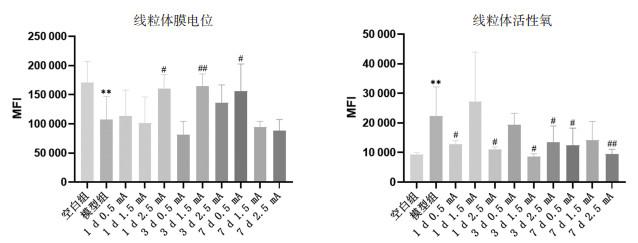
2 结果 2.1 不同电针参数预处理后各组小鼠肺脏线粒体功能的比较与空白组相比,模型组小鼠肺脏的线粒体膜电位显著降低(P<0.01),活性氧显著升高(P<0.01),提示脓毒症小鼠的肺脏线粒体功能被破坏;与模型组相比,电针1 d 2.5 mA组、3 d 1.5 mA组和7 d 0.5 mA组的小鼠肺脏线粒体膜电位显著升高(P<0.05),电针1 d 0.5 mA组、1 d 2.5 mA组、3 d 1.5 mA组、3 d 2.5 mA组、7 d 0.5 mA组和7 d 2.5 mA组活性氧显著降低(P<0.05),提示脓毒症小鼠的肺脏线粒体功能得到恢复。见图 1。结合团队前期研究不同电针参数对骨髓EVs数量的影响,确定后续实验选择电针参数为3 d 1.5 mA。
|
| 注:与空白组相比,**P<0.01;与模型组相比,#P<0.05,##P<0.01。 图 1 不同电针参数预处理后各组小鼠肺脏线粒体功能的比较(x ± s,n=5) Fig. 1 Comparison of pulmonary mitochondrial function in different groups of mice after pretreatment with different electroacupuncture parameters(x ± s, n=5) |
与空白组相比,模型组小鼠肺泡巨噬细胞的线粒体膜电位显著降低(P<0.01),活性氧显著升高(P<0.01),提示线粒体功能被破坏;与模型组相比,电针组小鼠肺泡巨噬细胞的线粒体膜电位显著升高(P<0.01),活性氧显著降低(P<0.01),提示线粒体功能得到恢复。见图 2。

|
| 注:与空白组相比,**P<0.01;与模型组相比,##P<0.01。 图 2 电针后各组小鼠肺泡巨噬细胞线粒体功能的比较(x ± s,n=5) Fig. 2 Comparison of mitochondrial function of alveolar macrophages in each group of mice after electroacupuncture(x ± s, n=5) |
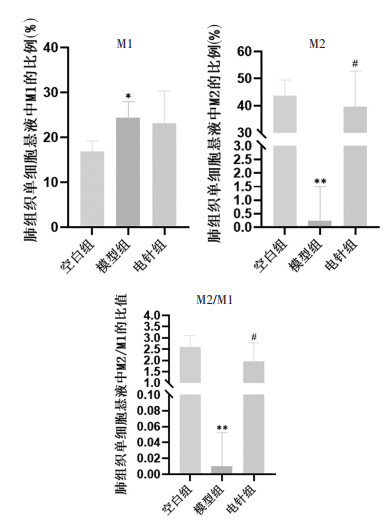
与空白组相比,模型组小鼠肺泡巨噬细胞中M1型巨噬细胞的比例上升(P<0.05),M2型巨噬细胞的比例下降(P<0.01),M2/M1的比例显著降低(P<0.01);与模型组相比,电针组小鼠肺泡巨噬细胞中M1型巨噬细胞的比例有下降趋势,M2型巨噬细胞的比例上升(P<0.05),M2/M1的比例显著升高(P<0.05)。提示电针可调节脓毒症小鼠肺泡巨噬细胞极化。见图 3。
|
| 注:与空白组相比,*P<0.05,**P<0.01;与模型组相比,#P<0.05。 图 3 电针后各组小鼠肺泡巨噬细胞极化情况的比较(x ± s,n=5) Fig. 3 Comparison of pulmonary alveolar macrophage polarization in each group after electroacupuncture (x ± s, n=5) |
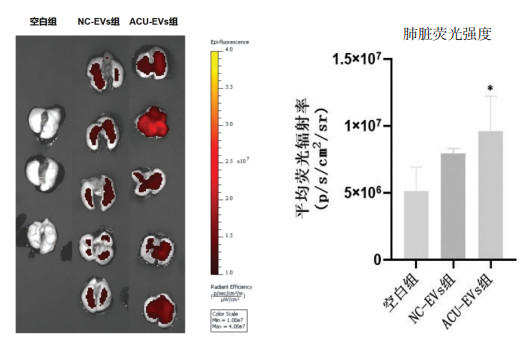
尾静脉回输骨髓EVs后8 h进行解剖,取出各组小鼠肺脏进行观测。与空白组相比,NC-EVs组的荧光强度有上升趋势;与NC-EVs组相比,ACU-EVs组的荧光强度显著升高(P<0.05)。说明ACU-EVs可以转移更多的线粒体到肺脏。见图 4。
|
| 注:与模型组相比,*P<0.05。 图 4 骨髓EVs转移线粒体至肺脏后各组小鼠体内荧光强度的比较(x ± s) Fig. 4 Comparison of fluorescence intensity in each group of mice after mitochondrial transfer from bone marrow EVs to lung(x ± s) |
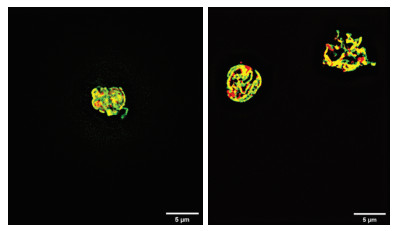
在HIS-SIM超分辨显微镜下观察到,小鼠胫骨骨髓来源外囊泡和线粒体有共定位,说明小鼠胫骨骨髓EVs可运载线粒体或线粒体片段。见图 5。
|
| 注:小鼠胫骨骨髓来源外囊泡(绿色),线粒体(红色),标尺=5 μm,100倍镜。 图 5 小鼠胫骨骨髓来源外囊泡中存在线粒体或线粒体片段 Fig. 5 Mitochondria or mitochondrial fragments were present in external vesicles derived from bone marrow of mouse tibia |
MH-S细胞和带有线粒体红色荧光信号的ACU-EVs共培养2 h后,激光共聚焦显微镜下观察到MH-S细胞内有红色荧光信号,说明ACU-EVs可以介导线粒体转移至肺泡巨噬细胞。见图 6。
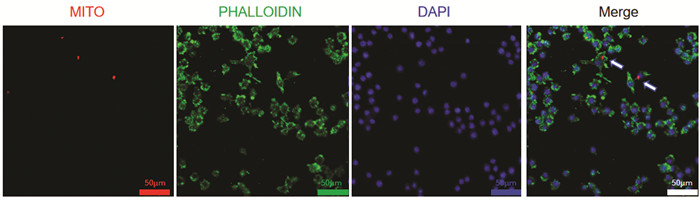
|
| 注:白色箭头示内有红色荧光信号的MH-S细胞,标尺=50 μm,40倍镜。 图 6 ACU-EVs介导线粒体转移至肺泡巨噬细胞(MH-S) Fig. 6 ACU-EVs mediated mitochondrial transfer to alveolar macrophages(MH-S) |
脓毒症严重威胁人类生命健康,过度炎症反应引发多器官功能障碍,其中肺脏是最先累及且损伤最为严重的脏器之一[10-12]。脓毒症肺损伤在临床上多以支持治疗为主,美国食品药品监督管理局(FDA)尚未批准治疗脓毒症的特效药物,目前仍缺乏特异性治疗方法[13-14]。
线粒体功能障碍是脓毒症肺损伤病理过程中的关键一环。线粒体参与细胞供能、调节细胞代谢等多种细胞过程,其损伤与脓毒症的发病机制有关[15]。脓毒症诱导的线粒体功能障碍可导致细胞代谢紊乱、产能不足和氧化应激,从而引起细胞凋亡,最终导致多器官衰竭,甚至死亡[16]。有研究[17]显示,在脓毒症早期,过量的活性氧会抑制线粒体呼吸,直接破坏线粒体蛋白和脂质膜等结构。Lowes等[18]也发现活性氧增加会导致线粒体膜电位降低,影响线粒体的正常功能。这与本研究结果一致,模型组小鼠肺泡巨噬细胞的膜电位降低、活性氧升高,其线粒体功能遭到了破坏,而经过电针预处理后,电针组小鼠肺泡巨噬细胞的膜电位升高、活性氧降低,说明电针起到了恢复脓毒症小鼠肺脏中肺泡巨噬细胞线粒体功能的作用。
电针对线粒体功能的调节可能是通过激活线粒体自噬、上调抗氧化酶活性和调控线粒体融合-分裂等实现的。电针预处理可能通过激活雷帕霉素靶蛋白复合体1(mTORC1)-ULK1-FUNDC1通路,促进受损线粒体的清除,减少线粒体DNA(mtDNA)泄漏和活性氧(ROS)积累,上调自噬相关蛋白(如LC3-Ⅱ)的表达[19-20]。此外,电针还可能通过上调线粒体融合蛋白[如超表达线粒体融合蛋白2基因(MFN2))和抑制分裂蛋白[如动力蛋白相关蛋白1(DRP1)],维持线粒体网络结构的完整,从而优化肺泡巨噬细胞的线粒体功能[21-24]。
国内外研究表明,线粒体代谢重编程是调控巨噬细胞极化表型的关键机制,其中M1型极化依赖于糖酵解供能,而M2型极化则通过脂肪酸氧化和氧化磷酸化(OXPHOS)维持长期能量需求[25-26]。在慢性阻塞性肺病(COPD)、肺纤维化等慢性肺部疾病中,肺泡巨噬细胞线粒体功能异常表现为呼吸链活性下降、活性氧(ROS)过量生成以及三羧酸(TCA)循环紊乱,这种代谢失衡会直接干扰极化相关信号通路[27-28]。Jiang等[26]发现线粒体膜电位降低和电子传递链功能障碍会激活NF-κB/STAT1通路,促进M1型极化并释放白细胞介素(IL)-1β、肿瘤坏死因子-α(TNF-α)等促炎因子,加剧肺部炎症。这些研究共同揭示了线粒体不仅是能量代谢的核心,更是巨噬细胞极化表型转换的调控枢纽,其功能障碍会影响脓毒症病理进程,为靶向线粒体通路的新型疗法提供了理论依据。本研究结果显示,脓毒症小鼠的肺泡巨噬细胞更多向M1促炎型极化,而经过电针预处理的脓毒症小鼠的肺泡巨噬细胞则更多向M2抗炎型极化,说明电针预处理可能是通过改善线粒体功能来调节肺泡巨噬细胞极化。
线粒体转移是指源于间充质干细胞的功能性线粒体可通过隧道纳米管形成、间隙连接、微囊泡、细胞融合和分离等几种不同模式转移到线粒体功能障碍的细胞中,恢复其有氧呼吸功能而发挥治疗作用[29],其中只有微囊泡可以实现远距离的线粒体转移,并可以通过整合素等实现靶向传输。团队前期研究[30-31]也发现,EVs作为“内源性针刺网络药”,运载有大量与针效相关的活性物质。因此,探究EVs能否介导线粒体转移至脓毒症小鼠受损的肺脏是研究的重点。本研究结果显示,运载有线粒体的ACU-EVs在脓毒症小鼠肺脏有特异性富集的现象,且EVs中的线粒体可以被小鼠肺泡巨噬细胞(MH-S)所摄取,进而调控肺泡巨噬细胞极化。
电针预处理可能通过转移健康线粒体至脓毒症小鼠肺脏中受损的肺泡巨噬细胞,帮助其线粒体代谢重编程、抑制氧化应激等多重机制,改善肺泡巨噬细胞的线粒体功能,从而调控受损的肺泡巨噬细胞向M2抗炎型极化[32-33]。
综上所述,电针可以通过骨髓EVs转移线粒体至脓毒症小鼠肺脏,改善肺泡巨噬细胞线粒体功能,调节肺泡巨噬细胞极化,进而发挥保护肺脏的作用。
| [1] |
唐艺丹, 许敏, 王蕊, 等. 针灸对脓毒症疗效与安全性的系统评价[J]. 中国循证医学杂志, 2020, 20(2): 174-180. |
| [2] |
李莉, 穆蕊, 余剑波, 等. 电针足三里穴和尺泽穴对脓毒症患者急性肺损伤的影响[J]. 中华麻醉学杂志, 2013, 33(5): 626-629. |
| [3] |
杨娜娜, 谭春霞, 李月婕, 等. 针刺调节外周炎性反应的研究进展[J]. 中国针灸, 2022, 42(9): 1078-1082. |
| [4] |
卓雪茂, 王美娟, 张靖宇, 等. 外泌体在电针抑制脓毒症小鼠炎症反应及提高生存率中的作用[J]. 中国免疫学杂志, 2023, 39(5): 973-977. |
| [5] |
胡细佑, 陈波, 陈泽林. 巨噬细胞极化在脓毒症发生发展中的作用[J]. 中华危重病急救医学, 2022, 34(6): 661-665. |
| [6] |
张圆. 基于线粒体融合-分裂动态平衡研究HO-1在电针刺内毒素急性肺损伤中的保护作用[D]. 天津: 天津医科大学, 2019.
|
| [7] |
TORRES-ROSAS R, YEHIA G, PEÑA G, et al. Dopamine mediates vagal modulation of the immune system by electroacupuncture[J]. Nature Medicine, 2014, 20(3): 291-5. DOI:10.1038/nm.3479 |
| [8] |
郭义. 实验针灸学[M]. 北京: 中国中医药出版社, 2021.
|
| [9] |
LIU S, WANG Z F, SU Y S, et al. Somatotopic organization and intensity dependence in driving distinct NPY-expressing sympathetic pathways by electroacupuncture[J]. Neuron, 2020, 108(3): 436-450. DOI:10.1016/j.neuron.2020.07.015 |
| [10] |
SINGER M, DEUTSCHMAN C S, SEYMOUR C W, et al. The third international consensus definitions for sepsis and septic shock(Sepsis-3)[J]. JAMA, 2016, 315(8): 801-10. DOI:10.1001/jama.2016.0287 |
| [11] |
BELLANI G, LAFFEY J G, PHAM T, et al. Epidemiology, patterns of care, and mortality for patients with acute respiratory distress syndrome in intensive care units in 50 countries[J]. JAMA, 2016, 315(8): 788-800. DOI:10.1001/jama.2016.0291 |
| [12] |
RUDD K E, JOHNSON S C, AGESA K M, et al. Global, regional, and national sepsis incidence and mortality, 1990-2017:Analysis for the global burden of disease study[J]. Lancet, 2020, 395(10219): 200-211. DOI:10.1016/S0140-6736(19)32989-7 |
| [13] |
ULLOA L, BRUNNER M, RAMOS L, et al. Scientific and clinical challenges in sepsis[J]. Current Pharmaceutical Design, 2009, 15(16): 1918-1935. DOI:10.2174/138161209788453248 |
| [14] |
ABRAHAM E, LATERRE P F, GARBINO J, et al. Lenercept(p55 tumor necrosis factor receptor fusion protein) in severe sepsis and early septic shock: A randomized, double-blind, placebo-controlled, multicenter phase Ⅲ trial with 1 342 patients[J]. Critical Care Medicine, 2001, 29(3): 503-510. |
| [15] |
HU D, SHEEJA P H, ZHANG Y Y, et al. Mitochondrial dysfunction in sepsis: Mechanisms and therapeutic perspectives[J]. Critical Care, 2024, 28(1): 292-292. DOI:10.1186/s13054-024-05069-w |
| [16] |
HUANG M, CAI S, SU J. The pathogenesis of sepsis and potential therapeutic targets[J]. International Journal of Molecular Sciences, 2019, 20(21): 5376-5736. DOI:10.3390/ijms20215376 |
| [17] |
DURAND A, DUBURCQ T, DEKEYSER T, et al. Involvement of mitochondrial disorders in septic cardiomyopathy[J]. Oxidative Medicine and Cellular Longevity, 2017, 2017: 1-13. |
| [18] |
LOWES D A, THOTTAKAM B M V, WEBSTER N R, et al. The mitochondria-targeted antioxidant MitoQ protects against organ damage in a lipopolysaccharide-peptidoglycan model of sepsis[J]. Free Radical Biology and Medicine, 2008, 45(11): 1559-1565. DOI:10.1016/j.freeradbiomed.2008.09.003 |
| [19] |
YOU Y, WANG H, WANG Q, et al. Silencing USP19 alleviates cigarette smoke extract-induced mitochondrial dysfunction in BEAS-2B cells by targeting FUNDC1[J]. Open Medicine, 2023, 18(1): 20230798. DOI:10.1515/med-2023-0798 |
| [20] |
GE X, WANG L, CUI Q, et al. Electroacupuncture improves cognitive impairment in diabetic cognitive dysfunction rats by regulating the mitochondrial autophagy pathway[J]. Journal of Physiological Sciences, 2022, 72(1): 29. DOI:10.1186/s12576-022-00854-0 |
| [21] |
ZENG T, LIU L, XU D, et al. The mitochondrial fusion promoter m1 mitigates cigarette smoke-induced airway inflammation and oxidative stress via the PI3K-AKT signaling pathway[J]. Lung, 2024, 203(1): 12. |
| [22] |
WU J, ZHANG D, LIU H, et al. Neuroprotective effects of apigenin on retinal ganglion cells in ischemia/reperfusion: Modulating mitochondrial dynamics in in vivo and in vitro models[J]. Journal of Translational Medicine, 2024, 22(1): 447. DOI:10.1186/s12967-024-05260-1 |
| [23] |
XU D, ZHANG K, QU X H, et al. Curcumin protects retinal neuronal cells against oxidative stress-induced damage by regulating mitochondrial dynamics[J]. Experimental Eye Research, 2022, 224: 109239. DOI:10.1016/j.exer.2022.109239 |
| [24] |
YUAN Z L, MO Y Z, LI D L, et al. Inhibition of ERK downregulates autophagy via mitigating mitochondrial fragmentation to protect SH-SY5Y cells from OGD/R injury[J]. Cell Communication and Signaling, 2023, 21(1): 204. DOI:10.1186/s12964-023-01211-3 |
| [25] |
LIU L, AN Z, ZHANG H, et al. Bone marrow mesenchymal stem cell-derived extracellular vesicles alleviate diabetes-exacerbated atherosclerosis via AMPK/mTOR pathway-mediated autophagy-related macrophage polarization[J]. Cardiovascular Diabetology, 2025, 24(1): 48. DOI:10.1186/s12933-025-02603-0 |
| [26] |
JIANG W, ZENG Q, LIU C H, et al. Huc-MSCs-derived exosomes alleviate non-alcoholic steatohepatitis by regulating macrophages polarization through miR-24-3p/STING axis[J]. Stem Cell Research & Therapy, 2025, 16(1): 74. |
| [27] |
SONG Q, ZHOU A, CHENG W, et al. Bone marrow mesenchymal stem cells-derived exosomes inhibit apoptosis of pulmonary microvascular endothelial cells in COPD mice through miR-30b/Wnt5a pathway[J]. International Journal of Nanomedicine, 2025, 20: 1191-1211. DOI:10.2147/IJN.S487097 |
| [28] |
GUO X, HUANG Z, WU F, et al. Exosomes of human adipose stem cells mitigate irradiation injury to salivary glands by inhibiting epithelial-mesenchymal transition through miR-199a-3p targeting Twist1 and regulating TGFβ1/Smad3 pathway[J]. Theranostics, 2025, 15(5): 1622-1641. DOI:10.7150/thno.102346 |
| [29] |
CHENG L, CHEUNG MARCO K H, SHUO H, et al. Mesenchymal stem cells and their mitochondrial transfer: A double-edged sword[J]. Bioscience Reports, 2019, 39(5): BSR201824177. |
| [30] |
李柠岑, 郭义, 陈波, 等. "针刺网络药"——基于针刺网络调节特点的外泌体转化应用策略[J]. 针刺研究, 2021, 46(6): 464-468. |
| [31] |
李柠岑, 李明月, 李牧洋, 等. 外泌体是针刺信息传递的重要途径[J]. 世界中医药, 2020, 15(7): 975-975. |
| [32] |
SHI J, PIAO M, LIU C, et al. Electroacupuncture pretreatment maintains mitochondrial quality control via HO-1/MIC60 signaling pathway to alleviate endotoxin-induced acute lung injury[J]. Biochimica Et Biophysica Acta-Molecular Basis of Disease, 2024, 1870(8): 167480. DOI:10.1016/j.bbadis.2024.167480 |
| [33] |
CHEN H, WU C, LYU Q, et al. Targeting mitochondrial homeostasis: The role of acupuncture in depression treatment[J]. Neuropsychiatric Disease And Treatment, 2023, 19: 1741-1753. DOI:10.2147/NDT.S421540 |
2. National Clinical Research Center for Chinese Medicine Acupuncture and Moxibustion, Tianjin 300381, China;
3. School of Medical Technology, Tianjin University of Traditional Chinese Medicine, Tianjin 301617, China