 2026, Vol. 43
文章信息
- 张海波, 葛雷, 陈昆, 等.
- ZHANG Haibo, GE Lei, CHEN Kun, et al.
- 鸦胆子苦素D调控AMPK/ULK1通路对膀胱癌细胞糖酵解的影响
- Effects of Bruceine D regulating the AMPK/ULK1 pathway on glycolysis in bladder cancer cells
- 天津中医药, 2026, 43(5): 613-619
- Tianjin Journal of Traditional Chinese Medicine, 2026, 43(5): 613-619
- http://dx.doi.org/10.11656/j.issn.1672-1519.2026.05.10
-
文章历史
- 收稿日期: 2026-02-25


膀胱癌是一种常见的泌尿系统恶性肿瘤,属中医“尿血”“癃闭”“淋证”范畴,其核心病机多责于湿热下注、瘀毒互结,治疗当以清热祛湿、化瘀解毒为主[1]。目前,吉西他滨和顺铂是临床上常用于治疗膀胱癌的化疗药物[2],但其毒副作用和获得性耐药会降低疗效,甚至可能导致治疗失败[3]。因此,开发疗效确切、毒性更低的新型药物以改善预后迫在眉睫。鸦胆子苦素D提取自鸦胆子,性味苦寒,归大肠、肝经,能清热解毒、蚀疮杀虫,其药性恰与膀胱癌“湿热瘀毒”的核心病机契合[4]。膀胱癌进展的关键特征涉及肿瘤细胞的异常增殖并伴随糖酵解增强[5],既往研究显示,能量代谢的核心调控因子AMP活化蛋白激酶(AMPK)可通过调控Unc-51样自噬激活激酶1(ULK1)介导自噬起始,进而影响肿瘤细胞增殖[6-7],有研究表明,鸦胆子苦素D可抑制结肠癌细胞增殖并诱导其凋亡[8]。鸦胆子苦素D是否通过调控该通路影响膀胱癌细胞增殖、凋亡、自噬及糖酵解等过程仍不清楚。本研究拟探讨鸦胆子苦素D对人膀胱癌T24细胞的作用及相关分子机制,以期为膀胱癌治疗提供新的理论依据。
1 材料与方法 1.1 实验细胞及动物人膀胱癌细胞系T24细胞购自中国科学院上海细胞库。4周龄雄性BALB/c裸鼠购自江苏集萃药康生物科技股份有限公司常州分公司,生产许可证号:SCXK(苏)2024-0016。所有实验流程均经本院伦理委员会审核并批准(批件号:YX-2024-273-01)。
1.2 主要试剂鸦胆子苦素D对照品(纯度≥98%,成都德思特生物技术有限公司);AMPK激活剂(AICAR)、AMPK抑制剂(Compound C,美国MCE公司);CCK-8试剂盒(深圳市安培生物科技有限公司);Annexin V-FITC细胞凋亡检测试剂盒(湖北百奥斯生物科技有限公司);乳酸检测试剂盒(上海通善生物技术有限公司);葡萄糖摄取试剂盒、RevertAidTMcDNA合成试剂盒(艾美捷科技有限公司);丙酮酸检测试剂盒(上海源叶生物科技有限公司);单丹磺酰戊二胺(MDC,上海金畔生物科技有限公司);兔源一抗Beclin1、微管相关蛋白1轻链3(LC3)、p-AMPK、AMPK、p-ULK1、ULK1、β-actin及羊抗兔免疫球蛋白(Ig)G二抗(英国Abcam公司)。
1.3 鸦胆子苦素D干预浓度筛选分别用浓度为0、0.1、0.2、0.4、0.8、1.6、3.2、6.4 μmol/L鸦胆子苦素D处理T24细胞24 h。随后,加入10 μL CCK-8试剂,孵育2 h。使用酶标仪测定细胞吸光度值并计算细胞活力。
1.4 细胞分组及干预在含10%胎牛血清的DMEM培养基培养T24细胞,培养条件:37 ℃、5% CO2。待培养至对数生长期,将T24细胞随机分为膀胱癌组、鸦胆子苦素D低浓度组、鸦胆子苦素D中浓度组、鸦胆子苦素D高浓度组、AICAR组、鸦胆子苦素D高浓度+AMPK抑制剂(Compound C)组。膀胱癌组不做其他处理。鸦胆子苦素D低、中、高浓度组:分别给药0.4、0.8、1.6 μmol/L鸦胆子苦素D[9]。AICAR组:给药10 nmol/L AICAR[10]。鸦胆子苦素D高浓度+Compound C组:给药1.6 μmol/L鸦胆子苦素D联合5 μmol/L Compound C[11]。给药24 h后,进行下游实验,检测指标变化。
1.5 观察指标 1.5.1 克隆形成实验检测T24细胞克隆形成数将各组T24细胞(800个细胞)接种于6 cm培养皿中,培养10 d。孵育结束后,使用甲醛固定菌落15 min。0.5%结晶紫染色30 min,随后计数细胞克隆形成数。
1.5.2 CCK-8试验检测T24细胞增殖情况将T24细胞接种于96孔板中(5×10³个/孔)。按1.4各分组干预处理后,每孔加入10 μL CCK-8试剂。孵育2 h后,使用多功能酶标仪在450 nm处测量吸光度。
1.5.3 流式细胞术检测T24细胞凋亡率收集各组T24细胞,磷酸缓冲盐溶液(PBS)洗涤后先加入结合缓冲液重悬细胞,再加入Annexin V-FITC和碘化丙啶避光孵育细胞15 min。以未处理组为对照,流式细胞仪FITC通道检测早期凋亡(Annexin V+/PI-),PI通道检测晚期凋亡(Annexin V+/PI+),FlowJo软件分析细胞凋亡率。
1.5.4 乳酸生成量、葡萄糖摄取量、丙酮酸生成量检测收集各组细胞上清液及细胞,利用乳酸检测试剂盒、葡萄糖摄取试剂盒、丙酮酸检测试剂盒测定细胞上清液中乳酸生成量、葡萄糖摄取量及细胞中丙酮酸生成量。
1.5.5 单丹磺酰尸胺(MDC)染色检测T24细胞自噬小体含量收集各组细胞,PBS洗涤、重悬细胞后,加入MDC染液避光孵育。经PBS洗涤去除多余染料后,使用中性树胶封片,荧光显微镜下观察染色情况。利用Image J软件定量各组细胞自噬小体相对含量。
1.5.6 实时荧光定量逆转录聚合酶链反应(qRT-PCR)检测T24细胞相关蛋白mRNA水平表达使用TRIzol试剂裂解T24细胞,获取总RNA。RevertAidTM cDNA合成试剂盒反转录合成cDNA。在ABI 7500 Real-Time PCR系统中使用SYBR Green Supermix试剂盒,以cDNA为模板进行qRT-PCR,检测增殖细胞核抗原(PCNA)、活化的半胱天冬酶-3(Cleaved Caspase-3)、丙酮酸激酶M2型(PKM2)、己糖激酶2(HK2)mRNA水平表达。以β-actin为内参进行归一化处理,2-ΔΔCt法计算基因相对表达量。引物序列为PCNA正向:5’-CCTGCTGGGATATTAGCTCCA-3’,反向:5’-GCACAGGTAAGGTTGCTGTTG-3’;Cleaved Caspase-3正向:5’-GAAATTGTGGAATTGATGCGTGA-3’,反向:5′-CTACAACGATCCCCTCTGAAAAA-3’;PKM2正向:5’-GCCGCCTGGACATTGACTC-3’,反向:5’-CCATGAGAGAAATTCAGCCGAG-3’;HK2正向:5’-GAGCCACCACTCACCCTACT-3’,反向:5’-CCAGGCATTCGGCAATGTG-3’;β-actin正向:5’-AGGGAAATCGTGCGTGAC-3’,反向:5’-CGCTCATTGCCGATAGTG -3’。
1.5.7 蛋白免疫印迹(Western blot)法检测T24细胞相关蛋白表达放射免疫沉淀法(RIPA)缓冲液提取T24细胞总蛋白,二喹啉甲酸(BCA)法定量蛋白浓度。采用10%十二烷基硫酸钠-聚丙烯酰胺凝胶电泳法分离40 μg蛋白,并将其转移至聚偏二氟乙烯膜上。5%脱脂牛奶阻断膜上非特异性结合位点后,加入一抗Beclin1(1∶1 000)、LC3(1∶3 000)、p-AMPK(1∶2 000)、AMPK(1∶4 000)、p-ULK1(1∶1 000)、β-actin(1∶3 000)、ULK1(1∶5 000)孵育过夜。次日,加入二抗(1∶4 000)室温孵育1 h。使用增强型化学发光底物试剂对特定信号进行可视化,Image J软件分析蛋白条带灰度值。
1.5.8 裸鼠膀胱癌移植瘤实验于BALB/c裸鼠右侧腋下皮下接种6×105个T24细胞。1周后,将裸鼠随机分配至对照组、鸦胆子苦素D组,每组5只。鸦胆子苦素D组每日腹腔注射2.5 mg/kg鸦胆子苦素D,对照组则给予等量生理盐水,每日1次,持续21 d。末次给药24 h后处死裸鼠,完整剥离瘤组织并称质量、测量体积。裂解部分瘤组织获得总蛋白,采用Western blot法检测p-AMPK/AMPK、p-ULK1/ULK1蛋白表达,以评估鸦胆子苦素D对AMPK/ULK1通路的潜在调控作用。
1.6 统计学方法使用GraphPad Prism 9进行统计分析。数据以均数±标准差(x±s)表示。多组间比较采用单因素方差分析,并结合SNK-q事后检验。P < 0.05为差异有统计学意义。
2 结果 2.1 鸦胆子苦素D浓度筛选在不同浓度鸦胆子苦素D处理下,T24细胞的活力呈剂量依赖性下降,其半数抑制浓度(IC50)约为1.6 μmol/L。基于此结果,本研究后续实验选用0.4、0.8和1.6 μmol/L分别作为处理T24细胞的低、中、高浓度。见表 1。
| 鸦胆子苦素D浓度(μmol/L) | n | T24细胞活力(%) |
| 0.0 | 6 | 100.00±0.00 |
| 0.1 | 6 | 98.97±0.12* |
| 0.2 | 6 | 93.26±0.43* |
| 0.4 | 6 | 82.49±5.15* |
| 0.8 | 6 | 65.43±3.87* |
| 1.6 | 6 | 48.97±2.59* |
| 3.2 | 6 | 32.11±1.96* |
| 6.4 | 6 | 13.44±0.78* |
| 注:与0 μmol/L鸦胆子苦素D比较,P < 0.05。 | ||
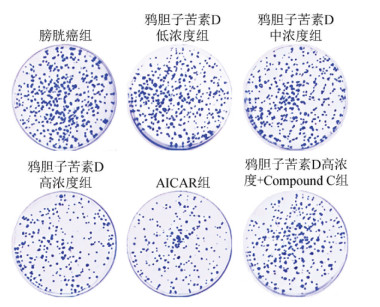
与膀胱癌组比较,鸦胆子苦素D低、中、高浓度组、AICAR组细胞克隆形成数、OD450值降低(P < 0.05);与鸦胆子苦素D高浓度组比较,鸦胆子苦素D高浓度+Compound C组T24细胞克隆形成数、OD450值升高(P < 0.05)。见图 1和表 2。
|
| 图 1 克隆形成实验检测T24细胞增殖的克隆形成实验 Fig. 1 Colony formation experiment for T24 cell proliferation |
| 组别 | n | 克隆形成数(个) | OD450值 | 凋亡率(%) |
| 膀胱癌组 | 6 | 326.68±17.78 | 1.26±0.13 | 4.67±0.25 |
| 鸦胆子苦素D低浓度组 | 6 | 276.65±15.57* | 1.02±0.10* | 8.95±0.51* |
| 鸦胆子苦素D中浓度组 | 6 | 221.44±10.98*# | 0.85±0.09*# | 13.67±0.78*# |
| 鸦胆子苦素D高浓度组 | 6 | 129.67± 7.86*#△ | 0.49±0.05*#△ | 20.63±1.15*#△ |
| AICAR组 | 6 | 121.33± 7.78* | 0.43±0.05* | 21.45±1.22* |
| 鸦胆子苦素D高浓度+Compound C组 | 6 | 200.68±11.45▲ | 0.73±0.08▲ | 15.63±0.86▲ |
| 注:与膀胱癌组比较,*P < 0.05;与鸦胆子苦素D低浓度组比较,#P < 0.05;与鸦胆子苦素D中浓度组比较,△P < 0.05;与鸦胆子苦素D高浓度组比较,▲P < 0.05。 | ||||
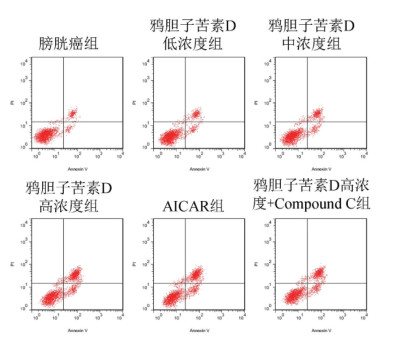
与膀胱癌组比较,鸦胆子苦素D低、中、高浓度组、AICAR组细胞凋亡率升高(P < 0.05);与鸦胆子苦素D高浓度组比较,鸦胆子苦素D高浓度+Compound C组细胞凋亡率降低(P < 0.05)。见图 2和表 2。
|
| 图 2 流式细胞术检测T24细胞凋亡 Fig. 2 Flow cytometry detection of apoptosis in T24 cells |
与膀胱癌组比较,鸦胆子苦素D低、中、高浓度组、AICAR组细胞乳酸生成量、葡萄糖摄取量、丙酮酸生成量降低(P < 0.05);与鸦胆子苦素D高浓度组比较,鸦胆子苦素D高浓度+Compound C组细胞乳酸生成量、葡萄糖摄取量、丙酮酸生成量升高(P < 0.05)。见表 3。
| 组别 | n | 乳酸生成量(μmol/L) | 葡萄糖摄取量(μmol/L) | 丙酮酸生成量(μmol/mg) | 自噬小体相对含量(%) |
| 膀胱癌组 | 6 | 21.18±1.09 | 9.06±0.46 | 0.65±0.04 | 41.65±2.34 |
| 鸦胆子苦素D低浓度组 | 6 | 17.91±0.95* | 7.37±0.38* | 0.51±0.04* | 51.97±2.52* |
| 鸦胆子苦素D中浓度组 | 6 | 12.73±0.81*# | 5.45±0.29*# | 0.40±0.03*# | 68.89±3.57*# |
| 鸦胆子苦素D高浓度组 | 6 | 5.46±0.31*#△ | 2.12±0.13*#△ | 0.15±0.01*#△ | 90.44±5.16*#△ |
| AICAR组 | 6 | 5.26±0.29* | 1.98±0.12* | 0.11±0.02* | 91.23±5.23* |
| 鸦胆子苦素D高浓度+Compound C组 | 6 | 10.62±0.63▲ | 3.89±0.20▲ | 0.34±0.04▲ | 75.67±4.14▲ |
| 注:与膀胱癌组比较,*P < 0.05;与鸦胆子苦素D低浓度组比较,#P < 0.05;与鸦胆子苦素D中浓度组比较,△P < 0.05;与鸦胆子苦素D高浓度组比较,▲P < 0.05。 | |||||
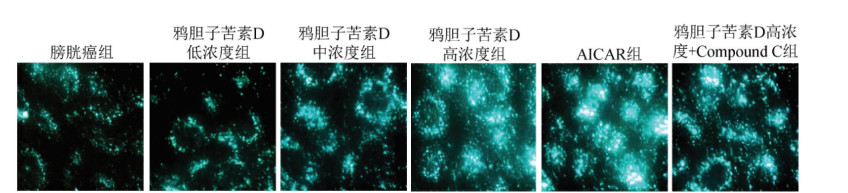
与膀胱癌组比较,鸦胆子苦素D低、中、高浓度组、AICAR组自噬小体相对含量升高(P < 0.05);与鸦胆子苦素D高浓度组比较,鸦胆子苦素D高浓度+Compound C组自噬小体相对含量降低(P < 0.05)。见图 3和表 3。
|
| 图 3 荧光显微镜观察T24细胞自噬小体形成(×400) Fig. 3 Autophagosome formation in T24 cells observed by fluorescence microscopy(×400) |
与膀胱癌组比较,鸦胆子苦素D低、中、高浓度组、AICAR组PCNA、PKM2、HK2 mRNA水平降低,Cleaved Caspase-3 mRNA水平升高(P < 0.05);与鸦胆子苦素D高浓度组比较,鸦胆子苦素D高浓度+Compound C组PCNA、PKM2、HK2 mRNA水平升高,Cleaved Caspase-3 mRNA水平降低(P < 0.05)。见表 4。
| 组别 | n | PCNA | Cleaved Caspase-3 | PKM2 | HK2 |
| 膀胱癌组 | 6 | 1.00±0.00 | 1.00±0.00 | 1.00±0.00 | 1.00±0.00 |
| 鸦胆子苦素D低浓度组 | 6 | 0.81±0.09* | 1.26±0.11* | 0.86±0.09* | 0.76±0.08* |
| 鸦胆子苦素D中浓度组 | 6 | 0.62±0.07*# | 1.59±0.13*# | 0.67±0.07*# | 0.31±0.04*# |
| 鸦胆子苦素D高浓度组 | 6 | 0.30±0.04*#△ | 1.95±0.16*#△ | 0.39±0.04*#△ | 0.13±0.02*#△ |
| AICAR组 | 6 | 0.28±0.03* | 2.06±0.18* | 0.34±0.03* | 0.11±0.02* |
| 鸦胆子苦素D高浓度+Compound C组 | 6 | 0.54±0.06▲ | 1.64±0.17▲ | 0.51±0.06▲ | 0.28±0.03▲ |
| 注:与膀胱癌组比较,*P < 0.05;与鸦胆子苦素D低浓度组比较,#P < 0.05;与鸦胆子苦素D中浓度组比较,△P < 0.05;与鸦胆子苦素D高浓度组比较,▲P < 0.05。 | |||||
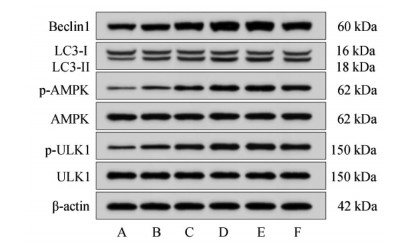
与膀胱癌组比较,鸦胆子苦素D低、中、高浓度组、AICAR组Beclin1、LC3-Ⅱ/LC3-Ⅰ、p-AMPK/AMPK、p-ULK1/ULK1蛋白表达升高(P < 0.05);与鸦胆子苦素D高浓度组比较,鸦胆子苦素D高浓度+Compound C组Beclin1、LC3-Ⅱ/LC3-Ⅰ、p-AMPK/AMPK、p-ULK1/ULK1蛋白表达降低(P < 0.05)。见图 4和表 5。
|
| 注:A,膀胱癌组;B,鸦胆子苦素D低浓度组;C,鸦胆子苦素D中浓度组;D,鸦胆子苦素D高浓度组;E,AICAR组;F,鸦胆子苦素D高浓度+Compound C组。 图 4 Beclin1、LC3-Ⅱ/LC3-Ⅰ、p-AMPK/AMPK、p-ULK1/ULK1蛋白条带图 Fig. 4 Protein band patterns of Beclin1, LC3-Ⅱ/LC3-Ⅰ, p-AMPK/AMPK, and p-ULK1/ULK1 |
| 组别 | n | Beclin1 | LC3-Ⅱ/LC3-Ⅰ | p-AMPK/AMPK | p-ULK1/ULK1 |
| 膀胱癌组 | 6 | 0.86±0.09 | 0.68±0.07 | 0.12±0.02 | 0.28±0.03 |
| 鸦胆子苦素D低浓度组 | 6 | 1.01±0.12* | 0.83±0.09* | 0.29±0.03* | 0.41±0.05* |
| 鸦胆子苦素D中浓度组 | 6 | 1.38±0.13*# | 1.12±0.14*# | 0.51±0.06*# | 0.65±0.07*# |
| 鸦胆子苦素D高浓度组 | 6 | 1.85±0.16*#△ | 1.57±0.15*#△ | 0.83±0.09*#△ | 0.90±0.08*#△ |
| AICAR组 | 6 | 1.91±0.17* | 1.65±0.16* | 0.86±0.09* | 0.92±0.08* |
| 鸦胆子苦素D高浓度+Compound C组 | 6 | 1.46±0.15▲ | 1.23±0.11▲ | 0.65±0.07▲ | 0.73±0.08▲ |
| 注:与膀胱癌组比较,*P < 0.05;与鸦胆子苦素D低浓度组比较,#P < 0.05;与鸦胆子苦素D中浓度组比较,△P < 0.05;与鸦胆子苦素D高浓度组比较,▲P < 0.05。 | |||||
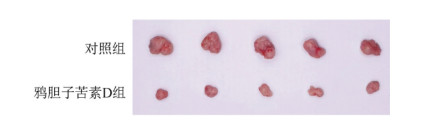
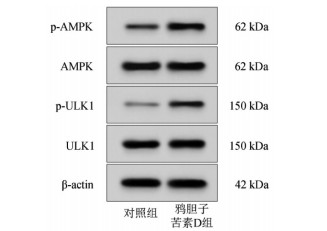
与对照组比较,鸦胆子苦素D组瘤组织质量、体积均降低,瘤组织p-AMPK/AMPK、p-ULK1/ULK1蛋白升高(P < 0.05)。见图 5、图 6及表 6。
|
| 图 5 肿瘤生长情况 Fig. 5 Tumer growth status |
|
| 图 6 裸鼠瘤组织p-AMPK/AMPK、p-ULK1/ULK1蛋白条带图 Fig. 6 Protein banding patterns of p-AMPK/AMPK and p-ULK1/ULK1 in tumor tissues of nude mice |
| 组别 | 动物数 | 瘤质量(g) | 瘤体积(mm3) | p-AMPK/AMPK | p-ULK1/ULK1 |
| 对照组 | 5 | 0.71±0.08 | 856.67±46.58 | 0.36±0.04 | 0.11±0.02 |
| 鸦胆子苦素D组 | 5 | 0.21±0.03* | 310.15±18.89* | 0.87±0.09* | 0.54±0.06* |
| 注:与对照组比较,*P < 0.05。 | |||||
肿瘤的发生与进展伴随着代谢重编程,这一特征为癌细胞持续增殖提供了物质基础[12]。在膀胱癌中,多种代谢通路协同重塑,其中以“有氧糖酵解”较为突出[13]。即便氧气充足,肿瘤细胞仍优先选择糖酵解供能。PKM2与HK2作为糖酵解限速酶,在多种肿瘤中普遍高表达,两者协同加速糖酵解通量,既为快速增殖的肿瘤细胞提供充足ATP,又生成大量合成前体,奠定了肿瘤“Warburg效应”的分子基础[14]。此外,糖酵解过程往往伴随大量丙酮酸及乳酸生成。乳酸的积累不仅指示葡萄糖摄取旺盛,还通过酸化微环境促进侵袭和转移,更为关键的是,乳酸本身作为信号分子,可直接调控肿瘤细胞的代谢、增殖和存活[15]。因此,糖酵解代谢转变引起的乳酸生成量、葡萄糖摄取量及丙酮酸生成量变化,也是衡量肿瘤进展的重要指标之一。本研究发现,低、中、高浓度的鸦胆子苦素D均可减少T24细胞的乳酸生成量,葡萄糖摄取量及丙酮酸生成量,降低PKM2、HK2、PCNA mRNA水平,加快细胞增殖(克隆形成数、OD450值增加),同时提高细胞凋亡率及Cleaved Caspase-3蛋白表达,这表明鸦胆子苦素D能够通过减缓糖酵解抑制T24细胞增殖,并诱导其凋亡。自噬对肿瘤细胞的增殖和凋亡具有重要调控作用,应激条件下,自噬可诱导细胞凋亡、抑制肿瘤生长[16]。最新研究显示,糖酵解生成的ATP可为自噬体形成、延伸及与溶酶体融合等步骤供能,确保自噬高效运转[17]。作为自噬起始的关键调控因子,Beclin1通过介导复合物组装启动自噬体成核;LC3经脂化修饰稳定锚定于延伸的自噬膜上,两者协同调控肿瘤细胞自噬的启动效率与通量水平,其表达及功能状态已成为评估肿瘤恶性程度及预后转归的关键指标[18]。本研究发现,不同浓度的鸦胆子苦素D均可增加T24细胞自噬小体相对含量,升高Beclin1、LC3-Ⅱ/LC3-Ⅰ蛋白表达,表明鸦胆子苦素D能够诱导T24细胞自噬。既往研究报道,鸦胆子苦素D可抑制肝癌细胞糖酵解及增殖,诱导宫颈癌细胞凋亡[19]。本研究与上述研究结果一致,证实了鸦胆子苦素D的抗肿瘤特性,提示鸦胆子苦素D可能是治疗膀胱癌的潜在有效药物。此外,在裸鼠移植瘤模型中,鸦胆子苦素D的治疗抑制了肿瘤生长,表现为瘤体质量和体积显著减少,从而在体内水平证实了其抗肿瘤活性。
AMPK/ULK1通路是细胞感知能量状态、启动自噬的核心枢纽,与肿瘤代谢重编程、恶性进展密切相关[20]。研究表明,激活AMPK/ULK1依赖性自噬可抑制结肠癌细胞增殖、诱导肝癌细胞凋亡[21]。本研究中,与膀胱癌组比较,AICAR组p-AMPK/AMPK、p-ULK1/ULK1蛋白表达升高,细胞增殖及糖酵解减弱,细胞自噬及凋亡能力增强,且AICAR为AMPK激活剂,表明激活AMPK/ULK1通路可抑制膀胱癌细胞恶性进展。此外,不同浓度的鸦胆子苦素D均可上调T24细胞p-AMPK/AMPK、p-ULK1/ULK1蛋白表达,推测鸦胆子苦素D可能通过激活AMPK/ULK1通路抑制T24细胞糖酵解,进而影响细胞自噬、增殖及凋亡。为验证此推测,本研究通过给药AMPK抑制剂—Compound C设置功能回复实验,结果显示,Compound C逆转了高浓度鸦胆子苦素D对T24细胞的抑制作用。体内实验数据与体外研究高度一致:鸦胆子苦素D显著上调了移植瘤中p-AMPK/AMPK和p-ULK1/ULK1的表达水平,从而在体内证实其抗肿瘤效应与激活AMPK/ULK1通路密切相关。
综上所述,鸦胆子苦素D可能通过激活AMPK/ULK1通路抑制T24细胞糖酵解、诱导细胞自噬,最终影响细胞增殖、凋亡进程。然而,必须指出的是,本研究的所有体外实验均仅基于单一人膀胱癌细胞系T24。不同膀胱癌细胞系在遗传背景、突变谱和生物学行为上存在异质性,因此,此发现可能受到细胞类型特异性的干扰,未来研究有必要在其他膀胱癌细胞系(如5637、J82等)及更复杂的临床前模型中进行验证,以进一步增强结论的可靠性。
| [1] |
ZHUANG J, MO J, HUANG Z, et al. Mechanisms of Xiaozheng Decoction for anti-bladder cancer effects via affecting the GSK3β/β-catenin signaling pathways: A network pharmacology-directed experimental investigation[J]. Chinese Medicine, 2023, 18(1): 104. DOI:10.1186/s13020-023-00818-5 |
| [2] |
XIE L, LIANG S, JIWA H, et al. Securinine inhibits the tumor growth of human bladder cancer cells by suppressing Wnt/β-catenin signaling pathway and activating p38 and JNK signaling pathways[J]. Biochemical Pharmacology, 2024, 223: 116125. DOI:10.1016/j.bcp.2024.116125 |
| [3] |
YANG K, QI Z X, SUN M X, et al. Hyperoside induces cell cycle arrest and suppresses tumorigenesis in bladder cancer through the interaction of EGFR-Ras and Fas signaling pathways[J]. International Journal of Medical Sciences, 2024, 21(4): 690-702. DOI:10.7150/ijms.90261 |
| [4] |
CHEN X, LI H. Bruceine D and narclasine inhibit the proliferation of breast cancer cells and the prediction of potential drug targets[J]. PLoS One, 2024, 19(1): e0297203. DOI:10.1371/journal.pone.0297203 |
| [5] |
TANIGUCHI K, MATSUMURA K, Ⅱ H, et al. Depletion of gamma-glutamylcyclotransferase in cancer cells induces autophagy followed by cellular senescence[J]. American Journal of Cancer Research, 2018, 8(4): 650-661. |
| [6] |
WANG R, XU F, YANG Z, et al. The mechanism of PFK-1 in the occurrence and development of bladder cancer by regulating ZEB1 lactylation[J]. BMC Urology, 2024, 24(1): 59. DOI:10.1186/s12894-024-01444-5 |
| [7] |
FEI X, LI Z, PAN Z, et al. Avermectin B1 mediates antitumor activity and induces autophagy in osteosarcoma through the AMPK/ULK1 signaling pathway[J]. Cancer Chemotherapy and Pharmacology, 2024, 94(4): 599-613. DOI:10.1007/s00280-024-04695-z |
| [8] |
盛钰翔, 蒋捷, 苑家福, 等. 鸦胆子苦素A抑制Wnt/β-catenin抗结肠癌细胞增殖及转移的作用研究[J]. 南京中医药大学学报, 2025, 41(2): 223-232. |
| [9] |
TANG W, HU Y, TU K, et al. Targeting Trop2 by Bruceine D suppresses breast cancer metastasis by blocking Trop2/β-catenin positive feedback loop[J]. Journal of Advanced Research, 2024, 58: 193-210. DOI:10.1016/j.jare.2023.05.012 |
| [10] |
高远, 李艳, 杜洪洋, 等. 鸢尾素通过调节AMPK/mTOR/ULK1通路对OGD/R诱导神经元损伤的影响及机制[J]. 中国老年学杂志, 2025, 45(3): 721-725. |
| [11] |
胡文奕, 张思思, 谢达奇. 冬凌草甲素调节AMPK/mTOR/ULK1信号通路对高糖诱导的心肌细胞自噬的影响[J]. 中国老年学杂志, 2024, 44(13): 3254-3258. |
| [12] |
SHEN D, DENG Z, LIU W, et al. Melatonin inhibits bladder tumorigenesis by suppressing PPARγ/ENO1-mediated glycolysis[J]. Cell Death and Disease, 2023, 14(4): 246. |
| [13] |
TAN M, PAN Q, YU C, et al. PIGT promotes cell growth, glycolysis, and metastasis in bladder cancer by modulating GLUT1 glycosylation and membrane trafficking[J]. Journal of Translational Medicine, 2024, 22(1): 5. |
| [14] |
TIAN Z, DAI Q, LIU B, et al. LncARSR promotes glioma tumor growth by mediating glycolysis through the STAT3/HK2 axis[J]. Cytokine, 2024, 180: 156663. DOI:10.1016/j.cyto.2024.156663 |
| [15] |
ZHONG J, XU A, XU P, et al. Circ_0000235 targets MCT4 to promote glycolysis and progression of bladder cancer by sponging miR-330-5p[J]. Cell Death Discovery, 2023, 9(1): 283. DOI:10.1038/s41420-023-01582-z |
| [16] |
ZHAO G, QI J, LI F, et al. TRAF3IP3 induces ER stress-mediated apoptosis with protective autophagy to inhibit lung adenocarcinoma proliferation[J]. Advanced Science, 2025, 12(17): e2411020. |
| [17] |
YAN X, YUAN C, WANG Z, et al. Berberine modulates ovarian cancer autophagy and glycolysis through the LINC01123/P65/MAPK10 signaling axis[J]. Phytomedicine, 2024, 135: 156121. |
| [18] |
SHAO B, BU H, LI G, et al. Autophagy-dependent apoptosis induction by oridonin are mediated by ROS-dependent AMPK-mTOR-ULK1 pathway in colon cancer[J]. American Journal of Cancer Research, 2025, 15(4): 1902-1918. |
| [19] |
黄睿. 鸦胆子苦素-D靶向ICAT抑制HIF-1α介导的肝癌细胞葡萄糖代谢作用机制研究[D]. 上海: 上海中医药大学, 2021.
|
| [20] |
YAO J, TANG S, SHI C, et al. Isoginkgetin, a potential CDK6 inhibitor, suppresses SLC2A1/GLUT1 enhancer activity to induce AMPK-ULK1-mediated cytotoxic autophagy in hepatocellular carcinoma[J]. Autophagy, 2023, 19(4): 1221-1238. |
| [21] |
WEN Z, QI J, RUAN Q, et al. Formosanin C induces autophagy-mediated cell death in hepatocellular carcinoma through activating DUSP1/AMPK/ULK1/Beclin1 signaling pathway[J]. Phytomedicine, 2025, 138: 156404. |