 2026, Vol. 45
文章信息
- 李小军, 魏辉, 王育伟, 贾顺江, 刘相辰, 祝泽伸, 千维娜
- LI Xiaojun, WEI Hui, WANG Yuwei, JIA Shunjiang, LIU Xiangchen, ZHU Zeshen, QIAN Weina
- 中医药调控TGF-β通路干预上皮-间质转化在肿瘤治疗中的应用
- Applications of traditional Chinese medicine targeting TGF-β pathway in EMT modulation for cancer therapy
- 天津中医药大学学报, 2026, 45(4): 493-503
- Journal of Tianjin University of Traditional Chinese Medicine, 2026, 45(4): 493-503
- http://dx.doi.org/10.11656/j.issn.1673-9043.2026.04.15
-
文章历史
收稿日期: 2025-11-17


引用本文 |


2. 陕西中医药大学附属医院肿瘤科, 咸阳 712000
2. Department of Oncology, Affiliated Hospital of Shaanxi University of Chinese Medicine, Xianyang 712000, China
肿瘤转移是导致癌症患者死亡的主要原因,也是当前治疗领域面临的核心挑战。当原发性肿瘤细胞挣脱束缚,通过淋巴、血管及种植转移等方式,在远隔器官形成新的转移灶时,通常意味疾病已经进入晚期,治疗难度也随之上升。上皮-间质转化(EMT)在此过程中扮演关键角色,它是指上皮细胞通过特定分子重编程,逐渐丧失细胞极性及细胞间连接,同时获得间质表型和迁移侵袭能力的过程。EMT不仅增强肿瘤细胞迁移侵袭能力,还可以赋予其类干细胞特性与化学治疗(简称化疗)耐药性,在恶性进展、治疗失败及肿瘤复发中发挥关键作用。因此,靶向EMT是遏制恶性肿瘤进展极具潜力的治疗方式。转化生长因子-β(TGF-β)信号通路是EMT最经典的上游调控途径。TGF-β信号由经典Smad通路与非Smad分支构成。在肿瘤微环境中,其通过多通路协调癌细胞表型可塑性,同时参与免疫抑制、细胞外基质(ECM)重塑及肿瘤血管生成等。基于上述原因,使得靶向TGF-β介导的EMT通路成为极具前景的抗肿瘤策略。
随着对中药研究的不断深入,中医药在调控TGF-β/EMT轴方面展现多靶点、整体调节的独特优势。其治疗策略不仅能逆转EMT表型、抑制肿瘤迁移和侵袭,还可以调节免疫微环境。诸多研究表明,黄芩苷、甘草酸等成分可以通过下调TGF-β1、抑制Smad2/3磷酸化等途径抑制EMT,丹参酮ⅡA可以通过抑制相关成纤维细胞(CAFs)活化间接阻断转移,黄酮类则通过抗炎、抗氧化削弱TGF-β诱导的EMT效应;此外,复方制剂中养肝解毒散结方、复方苦参注射液等也被证实可以通过调控TGF-β通路抑制肿瘤转移,从而抑制不同类型肿瘤进展。
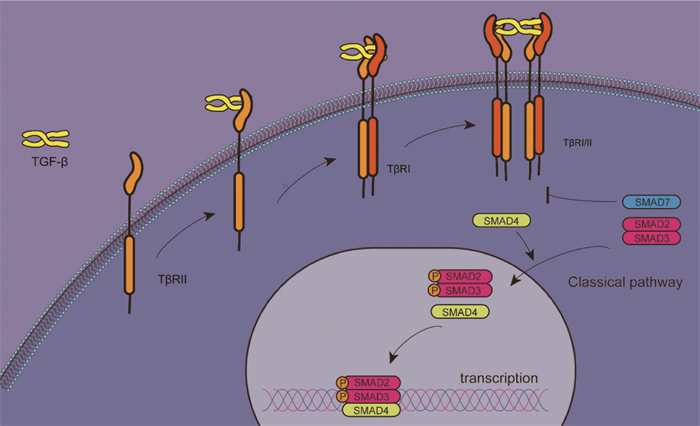
1 TGF-β信号通路经典的TGF-β信号传导通过Smad蛋白家族实现,始于配体激活与受体复合物组装,是从细胞膜表面受体传导到细胞核的过程,具有高度动态调控特征。癌细胞分泌的TGF-β1和TGF-β2配体以整合素依赖性方式被激活[1]。活化的TGF-β配体优先与TGFBR2(Ⅱ型受体)结合,诱导形成TGFBR2和TGFBR1的异四聚体复合物[2]。该复合物导致TGFBR1被磷酸化,随后磷酸化的TGFBR1会激活并进一步磷酸化Smad2/3[3]。磷酸化的Smad2/3与Smad4形成三聚体复合物,并通过核孔复合体异位到细胞核。在细胞核内对靶基因的表达进行调节[4]。Smad7以Smad2/3竞争TGFBR1磷酸化催化位点的方式,起到了抑制Smad2/3磷酸化的作用[5]。Smad蛋白是TGF-β信号通路的中枢介质。受体调节的Smad(R-Smad)可以被激活的Ⅰ型受体激酶磷酸化。抑制性Smad(Ⅰ-Smad)可以竞争性地抑制R-Smad磷酸化,从而拮抗TGF-β信号传导[6]。TGF-β信号通路的激活过程如图 1所示。
|
| 图 1 TGF-β信号通路示意图 |
TGF-β通路在肿瘤的发展中起到“双刃剑”的作用。在肿瘤发展早期,TGF-β作为一种有效的肿瘤抑制因子起到了抑制细胞周期、影响细胞分化、诱导细胞凋亡的作用[7]。它通过抑制肠上皮细胞异常增殖、刺激细胞分化以及诱导树突状细胞(DC)成熟与细胞毒性T细胞活化,抑制初始肿瘤克隆的免疫逃逸来抑制肿瘤发展。在肿瘤发展晚期则以促癌作用为主,异常的TGF-β信号通路会导致肿瘤的进展和转移[8]。TGF-β信号传导通过促进EMT、血管生成及基质重塑、创造免疫抑制微环境和维持干细胞特性来促进肿瘤的进展和转移。这4种转移机制形成了“TGF-β悖论”的病理基础[9]。
2 EMT的TGF-β调控EMT是发生在胚胎发育和成体组织稳态过程中的细胞重编程过程[10]。EMT在组织稳态和肿瘤发生等各种生理与病理条件中发挥至关重要的作用[11]。EMT过程在下调上皮标志物(E-cadherin、ZO-1和occludin)的同时上调间质标志物(N-cadherin、vimentin)的表达[12]。这一过程使具有黏附和凋亡能力的上皮细胞失去多边形的鹅卵石形态,获得了具有迁移和侵袭能力的呈现纺锤形态的间充质表型[13]。EMT激活后,肿瘤细胞的胞间连接溶解,顶端-基底极性被破坏,细胞骨架结构在肿瘤细胞中重组。这些物理变化使得细胞内渗进入血管并作为循环肿瘤细胞在血管中存活,随后从血管中外渗,最终导致肿瘤的远处转移[14]。
EMT是非二元可逆的生物过程,间充质-上皮转化(MET)作为其逆转过程,使得间充质细胞变回上皮状态[14]。这一过程是肿瘤成功转移定植的先决条件[15-16]。癌细胞依靠这两种过程进行不同程度的生长和转移。经历EMT过程的癌细胞,以循环肿瘤细胞的形式在血管存活并外渗实现远处播种和定植[12]。在接种后,癌细胞通过MET重新获得上皮表型,促使了细胞的定植和局部转移的发展。有研究表明,经由这一过程发育的癌细胞以其表型异质性的特点,产生了更强的适应性和抵抗性[16]。使其在增强侵袭性的同时降低了对化疗的敏感性。
TGF-β是EMT重要的诱导剂之一,作为关键调节因子调节癌细胞进展和转移[17]。TGF-β诱导EMT的过程,是通过下调紧密连接蛋白的表达导致紧密连接减弱。有研究显示,TGF-β表达水平较高的部分EMT状态的肿瘤细胞具有更高的侵袭和转移能力[18]。Smad依赖性通路在这一过程中发挥重要作用。有实验发现,Smad3/4于SNAIL1形成的复合物,下调了TGF-β驱动下的乳腺上皮细胞EMT期间E-cadherin的表达[19]。Smad4还可以下调Claudin1的表达,诱导肿瘤转移[20]。在慢性甲苯二异氰酸酯(TDI)诱导的支气管上皮细胞中TGF-β1的增加,使得大量的Smad2/3被激活,致使TGF-β通路激活,最终促进了EMT和支气管上皮细胞癌变[21]。在乳腺癌的研究中,Smad7介导TGF-β信号传导的负反馈T回路,当Smad7上调时,抑制TGF-β介导的乳腺肿瘤浸润和骨转移[22]。除此之外,Smad非依赖性通路通过溶解细胞连接和重塑细胞骨架来促进EMT[23]。PI3K/AKT通过AKT/PK和TGF-β之间的串扰诱导TWIST1磷酸化来促进肿瘤转移[24]。TGF-β1诱导Alu RNA表达,其积累会调节miR-566以促进EMT[25]。
3 分癌种应用与代表方药 3.1 肺癌肺癌从组织学角度,主要分为小细胞肺癌(SCLC)和非小细胞肺癌(NSCLC)两大亚型。临床诊疗根据具体的病理分型、肿瘤分期等因素选择个体化的治疗方案[26-27]。在肺癌的发生发展过程中,TGF-β信号通路通过诱导EMT发挥着复杂而关键的作用,且其作用因肺癌亚型而异,尤其在NSCLC中,TGF-β通路呈现出显著的阶段依赖性双重作用。在肿瘤早期,TGF-β通过p21/p15等细胞周期调控因子诱导细胞周期阻滞,发挥抑癌作用[28];然而,在肿瘤晚期,则转变为通过促进EMT和上调免疫检查点蛋白PD-L1表达,加速肿瘤转移和免疫逃逸[29]。这种促转移机制在EGFR突变型肺腺癌中尤为明显,TGF-β信号与EGFR突变之间存在协同效应,共同促进EMT进程和脑转移发生[30]。有研究表明,在EGFR突变患者中,vimentin高表达的NSCLC患者5年生存率显著降低40%,且经历EMT的肿瘤细胞对EGFR-TKI类药物如奥希替尼表现出明显耐药性[29, 31]。
靶向该通路已经成为抗肺癌药物研发的重要策略。多项研究揭示了中药及其活性成分在此领域的巨大潜力,它们通过多靶点作用干预该通路。6,6’-Bieckol作为海带藻中分离的提取物,通过调节TGF/β-Snail1/Twist1信号通路抑制EMT过程,并且通过Bcl-2和Caspases蛋白诱导细胞凋亡[32]。甲基莲心碱(Neferine)作为莲的活性成分,通过下调TGF-β信号通路,上调MST1表达,进而促进活性氧(ROS)生成并诱导细胞焦亡,在体外和小鼠模型中显著抑制NSCLC细胞的增殖、迁移侵袭及EMT过程,且这些抑制作用均呈现浓度依赖性[33]。在TGF-β1刺激的A549细胞中,蛇床子素(OST)通过NF-κB-Snail通路抑制,不仅逆转EMT表型,还同步削弱细胞黏附、侵袭及迁移能力[34]。蟾蜍素(Bufalin)作为中药蟾酥的核心活性成分,能够通过下调A549细胞中TβRⅠ和TβRⅡ的表达,有效抑制TGF-β诱导的EMT及细胞迁移过程[35]。补肺汤通过剂量依赖性地抑制TGF-β/Smad通路诱导的EMT,抑制TGF-β1诱导的A549细胞恶性表型[36]。β-榄香烯通过抑制TGF-β的表达,抑制M2型巨噬细胞分泌的促肿瘤因子,抑制肿瘤细胞的迁移和侵袭,同时通过促进细胞凋亡发挥抗肿瘤作用[37]。这些研究成果共同表明,中医药通过多成分、多靶点地调控TGF-β/EMT信号网络,在抑制肺癌进展方面展现出独特的整体调控优势和广阔的临床应用前景。代表性中药成分及机制总结见表 1。
| 成分 | 瘤种 | 实验模型 | 影响 | 分子机制 | 参考文献 |
| 6,6’-Bieckol | NSCLC | A549 | 增殖↓ | E-cadherin↑ | [32] |
| H1299 | 迁移↓ | Snail1↓ | |||
| 凋亡↑ | Twist1↓ | ||||
| EMT↓ | Fas/FasL ↑ | ||||
| Caspase-3/-8/-9↑ | |||||
| 甲基莲心碱 | NSCLC | A549 | 迁移↓ | E-cadherin↑ | [33] |
| H1299 | 侵袭↓ | N-cadherin↓ | |||
| 阻碍肿瘤生长 | Vimentin↓ | ||||
| MST1↑ | |||||
| TGF-β ↓ | |||||
| 蛇床子素 | NSCLC | A549 | 细胞周期停滞 | E-cadherin↑ | [34] |
| 迁移↓ | N-cadherin↓ | ||||
| 侵袭↓ | Vimentin↓ | ||||
| EMT↓ | Snail↓ | ||||
| p-p65↓ | |||||
| 蟾蜍素 | NSCLC | A549 | TGF β诱导的EMT ↓ | TβRⅠ↓ | [35] |
| 迁移↓ | TβRⅡ↓ | ||||
| E-cadherin↑ | |||||
| N-cadherin↓ | |||||
| Vimentin↓ | |||||
| β-榄香烯 | SCLC | NCI-H209 | 细胞凋亡↑ | TGF-β↓ | [37] |
| 细胞周期停滞 | |||||
| 补肺汤 | NSCLC | A549 | EMT↓ | E-cadherin↑ | [36] |
| N-cadherin↓ | |||||
| Fibronectin ↓ | |||||
| Vimentin↓ |
乳腺癌是全球女性最常见的恶性肿瘤,根据世界卫生组织国际癌症研究机构(IARC)最新数据,其年新发病例已经超过230万例[38]。当前乳腺癌治疗已经进入分子分型精准时代:激素受体阳性型依赖CDK4/6抑制剂联合内分泌治疗,HER2阳性型受益于抗HER2靶向治疗及抗体偶联药物(ADC)药物突破,而三阴性乳腺癌(TNBC)仍然面临转移率高、预后差的挑战[39-40]。由于缺乏雌激素受体(ER)、孕激素受体(PR)和HER2受体的表达,TGF-β信号通路的异常激活表现得尤为突出。多项研究证实,TNBC患者血清TGF-β1水平远高于非TNBC患者,并且其表达水平与肿瘤分期、转移风险和不良预后呈正相关[41]。这些证据表明,TGF-β1不仅是TNBC重要的预后生物标志物,更是一个关键的治疗干预靶点。
肿瘤微环境(TME)在TNBC的EMT过程中扮演关键角色。作为肿瘤细胞的“土壤”,为肿瘤细胞提供生长、增殖和转移的条件[42]。肿瘤相关成纤维细胞(CAFs)作为核心的驱动者,通过分泌TGF-β,并与白细胞介素(IL)-6等促炎因子形成协同调控网络,进一步驱动EMT的发展。CAFs不仅促进了EMT的进展,还通过建立转移前微环境为肿瘤细胞的远处转移创造了有利条件[43]。临床研究分析进一步证实,TNBC患者中TGF-β信号通路的高表达与肿瘤的强转移潜能和不良预后呈显著正相关[44]。多种中药活性成分能够干预TME中的TGF-β信号轴。黄芩苷通过抑制TGF-β/lncRNA-MALAT1/miR200c信号通路的激活显著抑制MDA-MB-231细胞的增殖、迁移和侵袭[45]。异川楝素通过逆转肿瘤微环境中TGF-β诱导的EMT,抑制TNBC转移,增强了抗PD-L1对TNBC的抑制作用[46]。鞣花酸以时间及剂量依赖性的方式通过诱导细胞周期停滞抑制MCF-7乳腺癌细胞的增殖,并且通过与Smad3抑制剂Ⅲ(SIS3)联合应用达到抑制TGF-β/Smad信号通路表达的作用[47]。姜黄素(Cur)能够调节TNBC细胞凋亡并通过SLC7A11/NF-κB/TGF-β信号通路抑制EMT,来抑制肿瘤发展[48],同时增强对紫杉醇的敏感性。积雪草苷(AC)增加PPARG表达阻断了P2RX7介导的TGF-β/Smad信号传导,来抑制TNBC细胞的迁移、侵袭和EMT[49]。党内酯(CLT)是白术的主要生物活性成分之一,通过抑制TGF-β信号通路和Runx2的磷酸化,来抑制EMT进程,从而抑制乳腺癌细胞的转移[50]。中医药成分通过多途径、多靶点的特点在EMT、转移及增敏化疗方面展现出广阔的应用前景。代表性中药成分及机制总结见表 2。
| 成分 | 瘤种 | 实验模型 | 影响 | 分子机制 | 参考文献 |
| 黄芩苷 | TNBC | MDA-MB-231 | 活力↓ | TGF-β↓ | [45] |
| 迁移↓ | ZEB1↓ | ||||
| 侵袭↓ | E-cadherin ↑ | ||||
| N-cadherin↓ | |||||
| miR-200c↑ | |||||
| 异川楝素 | TNBC | BALB/c雌性小鼠 | 迁移↓ | Vimentin ↓ | [46] |
| 侵袭↓ | α-SMA ↓ | ||||
| 逆转EMT | E-cadherin↑ | ||||
| 抗PD-L1疗效↑ | FSP1↑ | ||||
| 鞣花酸 | BC | MCF-7 | 细胞周期停滞 | Smad3↓ | [47] |
| 增殖↓ | P21↓ | ||||
| RB↑ | |||||
| 姜黄素 | TNBC | 4T1 | 迁移↓ | E-cadherin ↑ | [48] |
| MDA-MB-231 | 侵袭↓ | N-cadherin↓ | |||
| 雌性BALB/c小鼠 | 集落形成↓ | Vimentin ↓ | |||
| 促凋亡↑ | Caspase-9↑ | ||||
| EMT↓ | cleaved Caspase-3↑ | ||||
| Bax↑ | |||||
| Bcl-2 ↓ | |||||
| 积雪草苷 | TNBC | MDA-MB-231 | 迁移↓ | TGF-β1↓ | [49] |
| MDA-MB-453 | 侵袭↓ | p-Smad2/3↓ | |||
| EMT↓ | vimentin↓ | ||||
| E-cadherin ↑ | |||||
| ZO-1↑ | |||||
| 党内酯 | BC | MDA-MB-231、MDA-MB-468 | EMT↓ | E-cadherin ↑ | [50] |
| CK19↑ | |||||
| N-cadherin↓ | |||||
| Vimentin ↓ | |||||
| Snail↓Slug↓ | |||||
| Twist1↓ |
结直肠癌(CRC)是常见的消化道恶性肿瘤,其预后高度依赖于肿瘤分期。癌症转移是导致患者死亡的主要原因,在CRC中尤为突出,超过半数患者会在病程中发生转移。对于Ⅳ期的CRC患者而言,5年生存率甚至不足10%[51]。在CRC的进展中,TGF-β的激活程度与肿瘤转移密切相关,这在以间质表型为特征、侵袭性强的CMS4亚型中表现得尤为显著[52]。TGF-β信号通路与Wnt/β-catenin通路形成了复杂的交叉调控网络[53]。研究表明,活化的β-catenin通过转录抑制上皮表型维持因子,同时促进间质标志物的表达,为TGF-β驱动的EMT创造了有利的分子环境,极大地加速了癌细胞的上皮-间质转化过程,赋予癌细胞更强的迁移和侵袭能力[54]。这种双通路协同作用机制被认为是驱动CRC恶性进展的关键环节,其发生率在CRC中约占60%,尤其在APC基因突变的肿瘤中表现得更为突出[55]。
TGF-β介导的EMT在CRC转移过程中发挥着多方面作用。在肝转移这一CRC最常见的远处转移形式中,TGF-β不仅通过经典的Smad信号通路诱导EMT,还通过上调MMP-2/MMP-9等基质金属蛋白酶的活性,降解ECM,为肿瘤细胞的转移创造了有利的微环境条件[56]。TGF-β通过激活肝星状细胞,使其获得肌成纤维细胞特征,进而大量合成并分泌纤维连接蛋白、胶原蛋白等ECM成分,同时释放IL-6、TNF-α等促炎因子,共同重塑肝脏微环境,使其更适于肿瘤细胞的定植与生长[57-58]。此外,受细胞环境的影响,TGF-β与NF-κB信号传导常常协同串扰,进一步放大了促转移效应[59]。
在逆转EMT与诱导凋亡方面,小檗碱(BBR)通过调节TGF-β1/Smad通路的活性以及抑制NF-κB p65的表达,显著抑制HT29细胞的EMT进程并诱导癌细胞凋[60]。白藜芦醇通过浓度依赖性方式抑制LoVo细胞的侵袭迁移能力,下调TGF-β1/Smad信号通路并调控Snail/E-钙黏蛋白转录,从而抑制EMT过程并显著降低肺转移、肝转移的发生率[61]。在增敏化疗与逆转耐药方面,丹参素通过抑制TGF-β/Smad信号通路来减弱EMT样特性,抑制癌细胞的增殖迁移,并通过抑制MDR1的表达增强了化疗敏感性[62]。耐药性诱导HCT-8细胞发生EMT,表现为细胞形态改变及EMT调节因子表达异常[63],而片仔癀治疗不仅中和了这一过程,还以剂量依赖性方式抑制MDR/EMT增强的细胞迁移侵袭能力。机制方面,片仔癀通过阻断多药耐药(MDR)诱导的TGF-β/Smad4信号通路上调,逆转5-FU耐药细胞中的EMT表型,恢复化疗敏感性[64]。在多靶点抑制转移方面,健脾解毒汤可以通过TGF-β/Smad2/3介导的Snail/E-cadherin表达抑制EMT,在体内显著抑制CRC的肝、肺转移,延长荷瘤患者的生存时间[65]。氧化苦参碱是一种从苦参中提取的生物碱,已经被证明可以抑制各种类型癌细胞的生长。其通过靶向P38/PAI-1轴,抑制TGF-β1/Smad信号通路的激活,进而阻断EMT与抑制肿瘤转移[66]。雷公藤红素也有治疗结肠癌的作用[67]。代表性中药成分及机制总结见表 3。
| 成分 | 瘤种 | 实验模型 | 影响 | 分子机制 | 参考文献 |
| 小檗碱 | CRC | HT29 | 迁移↓ | E-cadherin ↑ | [60] |
| EMT↓ | N-cadherin ↓ | ||||
| p-Smad2/3↓ | |||||
| Smad7↑ | |||||
| 白藜芦醇 | CRC | LoVo | 迁移↓ | E-cadherin ↑ | [61] |
| 侵袭↓ | N-cadherin ↓ | ||||
| 肝转↓ | vimentin↓ | ||||
| 肺转↓ | |||||
| 丹参素 | CRC | SW620 | 迁移↓ | E-cadherin ↑ | [62] |
| EMT↓ | N-cadherin ↓ | ||||
| 化疗敏感↑ | vimentin↓ | ||||
| MDR1↓ | |||||
| 氧化苦参碱 | CRC | RKO | EMT ↓ | E-cadherin ↑ | [66] |
| α-SMA↓ | |||||
| FN↓ | |||||
| TGF-β1↓ | |||||
| PAI-1↓ | |||||
| Smad2↓ | |||||
| p-Smad2↓ | |||||
| 雷公藤红素 | CRC | HCT-116 | 增殖↓ | TGF-β1↓ | [67] |
| SW620 | 侵袭↓ | TGF-βRⅠ↓ | |||
| 迁移↓ | TGF-βRⅡ↓ | ||||
| EMT↓ | p-Smad2/3↓ | ||||
| Smad4↓ | |||||
| 片仔癀 | CRC | HCT-8/5-FU | 化疗耐药性↓ | E-cadherin↑ | [64] |
| 迁移↓ | N-cadherin ↓ | ||||
| 侵袭↓ | ZEB1↓ | ||||
| ZEB2 ↓ | |||||
| TGF-β ↓ | |||||
| Smad4↓ | |||||
| 健脾解毒汤 | CRC | LoVo | 侵袭↓ | E-cadherin↑ | [65] |
| 雌性BALB/c裸鼠 | 迁移↓ | Smad2/3↑ | |||
| 生存时间↑ | Vimentinp↓ | ||||
| EMT↓ | p-Smad2/3 ↓ | ||||
| Snail↓ |
TGF-β在多种实体瘤中均呈现异常高表达[68],TGF-β诱导的EMT过程在胃癌进展中发挥关键作用,显著影响肿瘤的侵袭转移能力并与患者预后密切相关[69]。南蛇藤提取物通过调节TGF-β通路,抑制胃癌细胞EMT过程,从而抑制了胃癌细胞的迁移和侵袭[70]。八宝丹已被证实能够显著抑制AGS和MGC80-3等胃癌细胞的增殖、迁移及侵袭能力。其作用机制涉及阻断TGF-β诱导的EMT过程,与抑制TGF-β/Smad信号通路的活化密切相关,为其抗肿瘤转移作用提供了分子层面依据[71]。
胰腺癌作为消化系统恶性肿瘤中预后极差的瘤种之一[72],其发病隐蔽、诊断难、预后差的特点,使得复发和转移极易发生。据统计,临床5年生存期仅为8%左右[73]。有研究表明,徐长卿提取物在非细胞毒性剂量下,通过下调TGF-β/Smad2/3通路,可以有效抑制EMT,显著降低胰腺癌细胞的转移能力[74]。
在肝细胞癌(HCC)从纤维化到癌变再到转移的发生发展过程中,TGF-β信号通路通过复杂的级联反应影响恶性进程[75]。大戟因子L2(EFL2)以浓度和时间双重依赖性方式,显著抑制肝癌细胞的增殖、迁移及克隆形成。其抗肿瘤机制涉及通过阻断AKT/STAT3信号轴,进而抑制TGF-β介导的EMT过程,最终实现肿瘤生长阻滞和转移抑制[76]。
在卵巢癌(OC)的研究中,其易发生腹膜转移的特殊性,使NK细胞疗法体现出独特价值[77]。积雪草苷通过下调NK细胞中TGFBR1表达,抑制Smad2磷酸化,维持线粒体完整性并保留NK细胞抗肿瘤活性[78]。此外,虫草素(Cd)通过抑制SKOV-3细胞活力、降低癌症干细胞比例、下调MMPs表达水平,并调控TGF-β诱导的EMT标志物变化,从而有效减弱癌细胞干性以及化疗耐药性,发挥抗卵巢癌的作用[79]。
在侵袭性强的鼻咽癌中,人参皂苷(Rg3)是从人参中提取的活性药物成分,其不仅能够抑制鼻咽癌细胞中MMP-2和MMP-9的表达,还能够逆转TGF-β诱导的EMT[80]。对于预后极差的胆囊癌,研究显示,灵芝是一种中药药材,通过超临界CO2萃取,获得灵芝孢子提取物,能够抑制TGF-β1诱导的EMT从而抑制肿瘤转移,还抑制F-肌动蛋白应力纤维形成[81]。川楝素亦可通过TGF-β通路调控EMT治疗胰腺癌[82]。代表性中药成分及机制总结见表 4。
| 成分 | 瘤种 | 实验模型 | 影响 | 分子机制 | 参考文献 |
| 南蛇藤提取物 | 胃癌 | SGC-7901 | 迁移↓ | E-cadherin ↑ | [70] |
| BGC-823 | 侵袭↓ | N-cadherin↓ | |||
| MGC-803 | vimentin↓ | ||||
| AGS cells | Smad2 ↓ | ||||
| Smad3↓ | |||||
| 八宝丹 | 胃癌 | AG | 活力↓ | TGF-β1 ↓ | [71] |
| MGC80-3 | 迁移↓ | p-Smad2/3↓ | |||
| 侵袭↓ | N-cadherin↓ | ||||
| EMT↓ | E-cadherin ↑ | ||||
| 徐长卿 | 胰腺癌 | Panc-1 | 增殖↓ | Caspase-3↑ | [74] |
| Capan-1 | 集落形成↓ | Caspase-9 ↑ | |||
| 迁移↓ | cleaved- | ||||
| 促凋亡↑ | PARP ↑ | ||||
| EMT↓ | E-cadherin ↑ | ||||
| N-cadherin ↓ | |||||
| vimentin↓ | |||||
| p-Smad2/3↓ | |||||
| 大戟因子L2 | HCC | Hep G2 | 增殖↓ | E-cadherin ↑ | [76] |
| SMMC-7721 | 迁移↓ | N-cadherin ↓ | |||
| 集落形成↓ | vimentin↓ | ||||
| EMT↓ | p-STAT3↓ | ||||
| 肿瘤生长↓ | |||||
| 积雪草苷 | OC | K562 | 对OC细胞的 | TGFBR1↓ | [78] |
| OVCAR8 | 细胞毒性↑ | p-SMAD2↓ | |||
| A2780 | |||||
| 虫草素 | OC | SKOV-3 | 化疗耐药性↓ | MMPs ↓ | [79] |
| EMT↓ | E-cadherin ↑ | ||||
| 癌症干性↓ | Vimentin ↓ | ||||
| 人参皂苷 | 鼻咽癌 | HNE1 | 迁移↓ | MMP-2↓ | [80] |
| CNE2 | 侵袭↓ | MMP-9↓ | |||
| E-cadherin↑ | [81] | ||||
| N-cadherin↓ | |||||
| Vimentin↓ | |||||
| ZEB1↓ | |||||
| 灵芝孢子 | 胆囊癌 | TFK-1 | 迁移↓ | E-cadherin↑ | |
| EMT↓ | N-cadherin↓ | ||||
| F-肌动蛋白 | Vimentin↓ | ||||
| 应力纤维↓ | |||||
| 川楝素 | 胰腺癌 | PANC-1 | 活力↓ | Vimentin ↓ | [82] |
| AsPC-1 | 增殖↓ | ZEB1 ↓ | |||
| 迁移↓ | SNAIL ↓ | ||||
| 侵袭↓ | E-cadherin ↑ | ||||
| 肿瘤生长↓ | Akt ↓ | ||||
| mTOR↓ |
本文系统综述了TGF-β/EMT在癌症发展中的核心作用,并重点讨论了中医药通过干预该轴心在抑制肿瘤转移中的研究进展。TGF-β信号通路在肿瘤晚期通过驱动EMT,赋予癌细胞迁移、侵袭、干细胞特性及治疗抵抗能力,已经成为抗癌药物研发的关键靶点。中医药凭借多靶点、多层次地调控TGF-β/EMT轴,这不仅是中医药“整体观念”和“辨证论治”理论在分子层面中的体现,也为控制肿瘤转移提供了极具价值的干预策略。
从本研究论述的各类型癌症可见,肺癌中的甲基莲心碱、蛇床子素,乳腺癌中的黄芩苷、异川楝素等,大量中药单体均被证实可以通过抑制TGF-β/Smad等经典通路,上调E-cadherin、下调N-cadherin与Vimentin等EMT标志物,有效逆转EMT表型,抑制癌细胞迁移与侵袭。值得注意的是,部分中药成分如姜黄素、积雪草苷,还能通过调节肿瘤微环境、影响相关成纤维细胞或免疫细胞功能,间接阻断TGF-β信号,展现了中医药干预的整体性与微环境重塑潜力。
尽管现有研究以中药单体为主,但中药复方凭借“多成分-多靶点-多通路”的协同作用和“君臣佐使”的配伍原则,在应对肿瘤这一复杂性疾病时,更能表现出中医药整体调节的特性。在面对TGF-β/EMT这样复杂的信号网络时,单一靶点抑制通常效果有限。而复方中的不同成分可以协同作用,达到在抑制TGF-β通路的同时兼顾抗炎、抗氧化或调节免疫微环境等多重效果。这种多环节的阻断,可能产生“1+1 > 2”的协同效应,更有效地逆转EMT进程。如片仔癀的研究表明,复方能够逆转由TGF-β/Smad通路介导的EMT同时恢复癌细胞对5-FU等化疗药物的敏感性。这提示复方可能具备同时攻击肿瘤的生存、转移和耐药机制的综合能力,为克服临床治疗提供新思路。
复方“多成分-多靶点”的优势也是其研究的难点所在。这导致药效物质基础难以明确,复方煎煮过程中可能生成新成分,造成机制阐释极为复杂。这种“机制不明”的状态严重制约了复方在基础研究中的验证与临床应用转化。
在这样的背景下,现代系统生物学与多组学技术的发展为阐明中药复方特异性调控TGF-β/EMT信号轴提供了巨大帮助。从计算预测到实验验证,再到临床关联的系统性研究策略仍是主要方法。首先,通过网络药理学与分子对接技术筛选出候选成分和靶点;进而,通过体内外实验对复方的关键药理表型进行系统研究,并从分子层面定位其干预通路的关键环节;进一步采用蛋白质组学、代谢组学等技术揭示复方调控潜在的新机制。最终将基础研究与临床疗效相结合,筛选出能够预测复方疗效的生物标志物,为精准用药提供依据。
基于上述所体现的复方潜力,当前研究的突破口主要聚焦于以下几个方向:其一,深入解析复方配伍规律在调控TGF-β/EMT轴中的协同机制;其二,研究中药复方在逆转EMT相关耐药中的作用,为克服化疗耐药提供创新方案;其三,寻找能够预测复方疗效的生物标志物,推动中医药在肿瘤治疗中的精准应用等方向。
综上所述,本研究通过系统梳理TGF-β/EMT轴与中医药在抗肿瘤转移中的关联,以及在不同癌种中的具体应用证据,旨在为后续机制研究、临床联合治疗及临床转化提供理论依据与方向指引。
| [1] |
ROBERTSON I B, RIFKIN D B. Regulation of the bioavail-ability of TGF-β and TGF-β-related proteins[J]. Cold Spring Harbor Perspectives in Biology, 2016, 8(6): 640-661. |
| [2] |
NAGARAJ N S, DATTA P K. Targeting the transforming growth factor-beta signaling pathway in human cancer[J]. Expert Opinion on Investigational Drugs, 2010, 19(1): 77-91. DOI:10.1517/13543780903382609 |
| [3] |
HELDIN C H, MOUSTAKAS A. Signaling receptors for TGF-β family members[J]. Cold Spring Harbor Perspectives in Biology, 2016, 8(8): 1017-1029. |
| [4] |
COLAK S, TEN DIJKE P. Targeting TGF-β signaling in cancer[J]. Trends in Cancer, 2017, 3(1): 56-71. DOI:10.1016/j.trecan.2016.11.008 |
| [5] |
NAKAO A, AFRAKHTE M, MORÉN A, et al. Identification of Smad7, a TGFbeta-inducible antagonist of TGF-beta signalling[J]. Nature, 1997, 389(6651): 631-635. DOI:10.1038/39369 |
| [6] |
ATTISANO L, WRANA J L. Signal transduction by the TGF-beta superfamily[J]. Science, 2002, 296(5573): 1646-1647. DOI:10.1126/science.1071809 |
| [7] |
SEOANE J, GOMIS R R. TGF-β family signaling in tumor suppression and cancer progression[J]. Cold Spring Harbor Perspectives in Biology, 2017, 9(12): 2085-2097. |
| [8] |
JUNG B, STAUDACHER J J, BEAUCHAMP D. Transforming growth factor β superfamily signaling in development of colorectal cancer[J]. Gastroenterology, 2017, 152(1): 36-52. DOI:10.1053/j.gastro.2016.10.015 |
| [9] |
HAQUE S, MORRIS J C. Transforming growth factor-β: A therapeutic target for cancer[J]. Human Vaccines & Immunotherapeutics, 2017, 13(8): 1741-1750. |
| [10] |
SINGH M, YELLE N, VENUGOPAL C, et al. EMT: Mechanisms and therapeutic implications[J]. Pharmacology & Therapeutics, 2018, 182: 80-94. |
| [11] |
SHIBUE T, WEINBERG R A. EMT, CSCs, and drug resistance: The mechanistic link and clinical implications[J]. Nature Reviews Clinical Oncology, 2017, 14(10): 611-629. DOI:10.1038/nrclinonc.2017.44 |
| [12] |
LAMOUILLE S, XU J, DERYNCK R. Molecular mechanisms of epithelial-mesenchymal transition[J]. Nature Reviews Molecular Cell Biology, 2014, 15(3): 178-196. DOI:10.1038/nrm3758 |
| [13] |
YE X, WEINBERG R A. Epithelial-mesenchymal plasticity: A central regulator of cancer progression[J]. Trends in Cell Biology, 2015, 25(11): 675-686. DOI:10.1016/j.tcb.2015.07.012 |
| [14] |
DONGRE A, WEINBERG R A. New insights into the mechanisms of epithelial-mesenchymal transition and implications for cancer[J]. Nature Reviews Molecular Cell Biology, 2019, 20(2): 69-84. DOI:10.1038/s41580-018-0080-4 |
| [15] |
BAKIR B, CHIARELLA A M, PITARRESI J R, et al. EMT, MET, plasticity, and tumor metastasis[J]. Trends in Cell Biology, 2020, 30(10): 764-776. DOI:10.1016/j.tcb.2020.07.003 |
| [16] |
HUANG Y, HONG W, WEI X. The molecular mechanisms and therapeutic strategies of EMT in tumor progression and metastasis[J]. Journal of Hematology & Oncology, 2022, 15(1): 129. |
| [17] |
HAO Y, BAKER D, TEN DIJKE P. TGF-β-mediated epithelial-mesenchymal transition and cancer metastasis[J]. International Journal of Molecular Sciences, 2019, 20(11): 101-115. |
| [18] |
PURAM S V, TIROSH I, PARIKH A S, et al. Single-cell transcriptomic analysis of primary and metastatic tumor ecosystems in head and neck cancer[J]. Cell, 2017, 171(7): 1611-1624. DOI:10.1016/j.cell.2017.10.044 |
| [19] |
DECKERS M, VAN DINTHER M, BUIJS J, et al. The tumor suppressor Smad4 is required for transforming growth factor beta-induced epithelial to mesenchymal transition and bone metastasis of breast cancer cells[J]. Cancer Research, 2006, 66(4): 2202-2209. DOI:10.1158/0008-5472.CAN-05-3560 |
| [20] |
SHIOU S R, SINGH A B, MOORTHY K, et al. Smad4 regulates claudin-1 expression in a transforming growth factor-beta-independent manner in colon cancer cells[J]. Cancer Research, 2007, 67(4): 1571-1579. DOI:10.1158/0008-5472.CAN-06-1680 |
| [21] |
HAN D H, SHIN M K, OH J W, et al. Chronic exposure to TDI induces cell migration and invasion via TGF-β1 signal transduction[J]. International Journal of Molecular Sciences, 2023, 24(7): 1001-1020. |
| [22] |
YU J, LEI R, ZHUANG X, et al. MicroRNA-182 targets SMAD7 to potentiate TGFβ-induced epithelial-mesenchymal transition and metastasis of cancer cells[J]. Nature Communications, 2016, 7: 13884. DOI:10.1038/ncomms13884 |
| [23] |
THIERY J P, ACLOQUE H, HUANG R Y, et al. Epithelial-mesenchymal transitions in development and disease[J]. Cell, 2009, 139(5): 871-890. DOI:10.1016/j.cell.2009.11.007 |
| [24] |
XUE G, RESTUCCIA D F, LAN Q, et al. Akt/PKB-mediated phosphorylation of Twist1 promotes tumor metastasis via mediating cross-talk between PI3K/Akt and TGF-β signaling axes[J]. Cancer Discovery, 2012, 2(3): 248-259. DOI:10.1158/2159-8290.CD-11-0270 |
| [25] |
DI RUOCCO F, BASSO V, RIVOIRE M, et al. Alu RNA accumulation induces epithelial-to-mesenchymal transition by modulating miR-566 and is associated with cancer progression[J]. Oncogene, 2018, 37(5): 627-637. DOI:10.1038/onc.2017.369 |
| [26] |
CHOUDHARY N, BAWARI S, BURCHER J T, et al. Targeting cell signaling pathways in lung cancer by bioactive phytocompounds[J]. Cancers, 2023, 15(15): 2322-2340. |
| [27] |
CHEN Y, TANG W Y, TONG X, et al. Pathological transition as the arising mechanism for drug resistance in lung cancer[J]. Cancer Communications, 2019, 39(1): 53. DOI:10.1186/s40880-019-0402-8 |
| [28] |
SEOANE J. p21(WAF1/CIP1) at the switch between the anti-oncogenic and oncogenic faces of TGFbeta[J]. Cancer Biology & Therapy, 2004, 3(2): 226-227. |
| [29] |
JEONG H, KOH J, KIM S, et al. Epithelial-mesenchymal transition induced by tumor cell-intrinsic PD-L1 signaling predicts a poor response to immune checkpoint inhibitors in PD-L1-high lung cancer[J]. British Journal of Cancer, 2024, 131(1): 23-36. DOI:10.1038/s41416-024-02698-4 |
| [30] |
KURIMOTO R, IWASAWA S, EBATA T, et al. Drug resistance originating from a TGF-β/FGF-2-driven epithelial-to-mesenchymal transition and its reversion in human lung adenocarcinoma cell lines harboring an EGFR mutation[J]. International Journal of Oncology, 2016, 48(5): 1825-1836. DOI:10.3892/ijo.2016.3419 |
| [31] |
TAKAHASHI H, SAKAKIBARA-KONISHI J, FURUTA M, et al. Notch pathway regulates osimertinib drug-tolerant persistence in EGFR-mutated non-small-cell lung cancer[J]. Cancer Science, 2023, 114(4): 1635-1650. DOI:10.1111/cas.15674 |
| [32] |
LI Y, LIU M, YANG K, et al. 6, 6'-Bieckol induces apoptosis and suppresses TGF-β-induced epithelial-mesenchymal transition in non-small lung cancer cells[J]. Chinese Herbal Medicines, 2022, 14(2): 254-262. DOI:10.1016/j.chmed.2021.05.005 |
| [33] |
ZHONG P C, LIU Z W, XING Q C, et al. Neferine inhibits the development of lung cancer cells by downregulating TGF-β to regulate MST1/ROS-induced pyroptosis[J]. The Kaohsiung Journal of Medical Sciences, 2023, 39(11): 1106-1118. DOI:10.1002/kjm2.12752 |
| [34] |
FENG H, LU J J, WANG Y, et al. Osthole inhibited TGF β-induced epithelial-mesenchymal transition(EMT) by suppressing NF-κB mediated Snail activation in lung cancer A549 cells[J]. Cell Adhesion & Migration, 2017, 11(5-6): 464-475. |
| [35] |
ZHAO L, LIU S, CHE X, et al. Bufalin inhibits TGF-β-in-duced epithelial-to-mesenchymal transition and migration in human lung cancer A549 cells by downregulating TGF-β receptors[J]. International Journal of Molecular Medicine, 2015, 36(3): 645-652. DOI:10.3892/ijmm.2015.2268 |
| [36] |
HE X R, HAN S Y, LI X H, et al. Chinese medicine BuFei decoction attenuates epithelial-mesenchymal transition of non-small cell lung cancer via inhibition of transforming growth factor β1 signaling pathway in vitro and in vivo[J]. Journal of Ethnopharmacology, 2017, 204: 45-57. DOI:10.1016/j.jep.2017.04.008 |
| [37] |
HUANG W, FU B, XU H. β-elemene inhibits tumor-promoting in small cell lung cancer by affecting M2 macrophages and TGF-β[J]. BMC Pulmonary Medicine, 2025, 25(1): 97. DOI:10.1186/s12890-025-03533-z |
| [38] |
SMOLARZ B, NOWAK A Z, ROMANOWICZ H. Breast cancer-epidemiology, classification, pathogenesis and treatment(review of literature)[J]. Cancers, 2022, 14(10): 2901-2914. |
| [39] |
PANDEY K, PARK N, PARK K S, et al. Combined CDK2 and CDK4/6 inhibition overcomes palbociclib resistance in breast cancer by enhancing senescence[J]. Cancers, 2020, 12(12): 1024-1036. |
| [40] |
YAM C, HUNG M C, HORTOBAGYI G N. CDK4/6 inhibitors in hormone receptor-positive, human epidermal growth factor receptor 2(HER2)-negative metastatic breast cancer: Are we at the finish line?[J]. Oncotarget, 2018, 9(76): 34193-34195. DOI:10.18632/oncotarget.26134 |
| [41] |
BAHHNASSY A, MOHANAD M, SHAARAWY S, et al. Transforming growth factor-β, insulin-like growth factor Ⅰ/insulin-like growthfactor Ⅰ receptor and vascular endothelial growth factor-A: Prognostic and predictive markers in triplenegative and non-triple-negative breast cancer[J]. Molecular Medicine Reports, 2015, 12(1): 851-864. DOI:10.3892/mmr.2015.3560 |
| [42] |
ZHENG S, ZOU Y, TANG Y, et al. Landscape of cancer-associated fibroblasts identifies the secreted biglycan as a protumor and immunosuppressive factor in triple-negative breast cancer[J]. OncoImmunology, 2022, 11(1): 2020984. DOI:10.1080/2162402X.2021.2020984 |
| [43] |
ERDOGAN B, WEBB D J. Cancer-associated fibroblasts modulate growth factor signaling and extracellular matrix remodeling to regulate tumor metastasis[J]. Biochemical Society Transactions, 2017, 45(1): 229-236. DOI:10.1042/BST20160387 |
| [44] |
SULAIMAN A, MCGARRY S, CHILUMULA S C, et al. Clinically translatable approaches of inhibiting TGF-β to target cancer stem cells in TNBC[J]. Biomedicines, 2021, 9(10): 1554-1559. |
| [45] |
LI J, LIU H, LIN Q, et al. Baicalin suppresses the migration and invasion of breast cancer cells via the TGF-β/ln-cRNA-MALAT1/miR-200c signaling pathway[J]. Medicine, 2022, 101(46): e29328. DOI:10.1097/MD.0000000000029328 |
| [46] |
ZHANG J, ZHANG Z, HUANG Z, et al. Isotoosendanin exerts inhibition on triple-negative breast cancer through abrogating TGF-β-induced epithelial-mesenchymal transition via directly targeting TGFβR1[J]. Acta Pharmaceutica Sinica B, 2023, 13(7): 2990-3007. DOI:10.1016/j.apsb.2023.05.006 |
| [47] |
LU G, WANG X, CHENG M, et al. The multifaceted mechanisms of ellagic acid in the treatment of tumors: State-of-the-art[J]. Biomedicine & Pharmacotherapy, 2023, 165: 115132. |
| [48] |
LI F, QI Q, QIAO Y, et al. Curcumenol inhibits malignant progression and promotes ferroptosis via the SLC7A11/NFκB/TGF-β pathway in triple-negative breast cancer[J]. International Journal of Molecular Medicine, 2025, 56(1): 101-107. |
| [49] |
HUANG X, JIA Z, LI X, et al. Asiaticoside hampers epithelial-mesenchymal transition by promoting PPARG expression and suppressing P2RX7-mediated TGF-β/Smad signaling in triple-negative breast cancer[J]. Phytotherapy Research, 2023, 37(5): 1771-1786. DOI:10.1002/ptr.7692 |
| [50] |
FU J, KE X, TAN S, et al. The natural compound codonolactone attenuates TGF-β1-mediated epithelial-to-mesenchymal transition and motility of breast cancer cells[J]. Oncology Reports, 2016, 35(1): 117-126. DOI:10.3892/or.2015.4394 |
| [51] |
SIEGEL R L, MILLER K D, GODING SAUER A, et al. Colorectal cancer statistics, 2020[J]. CA: A Cancer Journal for Clinicians, 2020, 70(3): 145-164. DOI:10.3322/caac.21601 |
| [52] |
ZHOU H, LIU Z, WANG Y, et al. Colorectal liver metastasis: Molecular mechanism and interventional therapy[J]. Signal Transduction and Targeted Therapy, 2022, 7(1): 70. |
| [53] |
HUANG D, DU X. Crosstalk between tumor cells and microenvironment via Wnt pathway in colorectal cancer dissemination[J]. World Journal of Gastroenterology, 2008, 14(12): 1823-1827. DOI:10.3748/wjg.14.1823 |
| [54] |
KIM W K, KWON Y, JANG M, et al. β-catenin activation down-regulates cell-cell junction-related genes and induces epithelial-to-mesenchymal transition in colorectal cancers[J]. Scientific Reports, 2019, 9(1): 18440. DOI:10.1038/s41598-019-54890-9 |
| [55] |
HE K, GAN W J. Wnt/β-catenin signaling pathway in the development and progression of colorectal cancer[J]. Cancer Management and Research, 2023, 15: 435-448. DOI:10.2147/CMAR.S411168 |
| [56] |
FASANO M, PIROZZI M, MICELI C C, et al. TGF-β modulated pathways in colorectal cancer: New potential therapeutic opportunities[J]. International Journal of Molecular Sciences, 2024, 25(13): 23221-23228. |
| [57] |
FABREGAT I, CABALLERO-DÍAZ D. Transforming growth factor-β-induced cell plasticity in liver fibrosis and hepatocarcinogenesis[J]. Frontiers in Oncology, 2018, 8: 357. |
| [58] |
LI J, MA X, CHAKRAVARTI D, et al. Genetic and biological hallmarks of colorectal cancer[J]. Genes & Development, 2021, 35(11-12): 787-820. |
| [59] |
WANG Y, JIN Z, JIA S, et al. Mechanical stress protects against chondrocyte pyroptosis through TGF-β1-mediated activation of Smad2/3 and inhibition of the NF-κB signaling pathway in an osteoarthritis model[J]. Biomedicine & Pharmacotherapy, 2023, 159: 114216. |
| [60] |
HUANG C, LIU H, YANG Y, et al. Berberine suppressed the epithelial-mesenchymal transition(EMT) of colon epithelial cells through the TGF-β1/Smad and NF-κB pathways associated with miRNA-1269a[J]. Heliyon, 2024, 10(16): e36059. |
| [61] |
JI Q, LIU X, HAN Z, et al. Resveratrol suppresses epithelial-to-mesenchymal transition in colorectal cancer through TGF-β1/Smads signaling pathway mediated Snail/E-cadherin expression[J]. BMC Cancer, 2015, 15: 97. |
| [62] |
CAO Y, LU K, XIA Y, et al. Danshensu attenuated epithelial-mesenchymal transformation and chemoresistance of colon cancer cells induced by platelets[J]. Frontiers in Bioscience(Landmark Edition), 2022, 27(5): 160. |
| [63] |
PASQUALATO A, PALOMBO A, CUCINA A, et al. Quantitative shape analysis of chemoresistant colon cancer cells: Correlation between morphotype and phenotype[J]. Experimental Cell Research, 2012, 318(7): 835-846. |
| [64] |
SHEN A, CHEN H, CHEN Y, et al. Pien Tze Huang overcomes multidrug resistance and epithelial-mesenchymal transition in human colorectal carcinoma cells via suppression of TGF-β pathway[J]. Evidence-Based Complementary and Alternative Medicine, 2014, 2014: 679436. |
| [65] |
LIU X, JI Q, DENG W, et al. JianPi JieDu recipe inhibits epithelial-to-mesenchymal transition in colorectal cancer through TGF-β/Smad mediated Snail/E-cadherin expression[J]. BioMed Research International, 2017, 2017: 2613198. |
| [66] |
WANG X, LIU C, WANG J, et al. Oxymatrine inhibits the migration of human colorectal carcinoma RKO cells via inhibition of PAI-1 and the TGF-β1/Smad signaling pathway[J]. Oncology Reports, 2017, 37(2): 747-753. |
| [67] |
JIANG Z, CAO Q, DAI G, et al. Celastrol inhibits colorectal cancer through TGF-β1/Smad signaling[J]. OncoTargets and Therapy, 2019, 12: 509-518. |
| [68] |
MCGRAIL D J, PILIÉ P G, RASHID N U, et al. High tumor mutation burden fails to predict immune checkpoint blockade response across all cancer types[J]. Annals of Oncology, 2021, 32(5): 661-672. |
| [69] |
XIA P, XU X Y. Epithelial-mesenchymal transition and gastric cancer stem cell[J]. Tumor Biology, 2017, 39(5): 1010-1020. |
| [70] |
WANG H, CHU Z, OU S, et al. Celastrus orbiculatus extract inhibits the epithelial-mesenchymal transition process by transforming growth factor-β signaling pathway in gastric cancer[J]. Anti-Cancer Agents in Medicinal Chemistry, 2022, 22(12): 2282-2291. |
| [71] |
LIU J, CHEN Y, CAO Z, et al. Babao Dan inhibits the migration and invasion of gastric cancer cells by suppressing epithelial-mesenchymal transition through the TGF-β/Smad pathway[J]. The Journal of International Medical Research, 2020, 48(6): 300-311. |
| [72] |
CAI J, CHEN H, LU M, et al. Advances in the epidemiology of pancreatic cancer: Trends, risk factors, screening, and prognosis[J]. Cancer Letters, 2021, 520: 1-11. |
| [73] |
MAISONNEUVE P. Epidemiology and burden of pancreatic cancer[J]. Presse Médicale, 2019, 48(3Pt2): e113-e123. |
| [74] |
CHENG C S, WU Y, JIN J B, et al. Cynanchum paniculatum(Bunge) Kitag. ex H. Hara inhibits pancreatic cancer progression by inducing caspase-dependent apoptosis and suppressing TGF-β-mediated epithelial-mesenchymal transition[J]. Frontiers in Pharmacology, 2024, 15: 1284371. |
| [75] |
WANG H, WANG P, XU M, et al. Distinct functions of transforming growth factor-β signaling in c-MYC driven hepatocellular carcinoma initiation and progression[J]. Cell Death & Disease, 2021, 12(2): 200. |
| [76] |
FAN L, ZHU H, TAO W, et al. Euphorbia factor L2 inhibits TGF-β-induced cell growth and migration of hepatocellular carcinoma through AKT/STAT3[J]. Phytomedicine, 2019, 62: 152931. |
| [77] |
FAN Z, HAN D, FAN X, et al. Ovarian cancer treatment and natural killer cell-based immunotherapy[J]. Frontiers in Immunology, 2023, 14: 1308143. |
| [78] |
GUO Y, XU J, JIA Y, et al. Asiaticoside modulates human NK cell functional fate by mediating metabolic flexibility in the tumor microenvironment[J]. Phytomedicine, 2024, 133: 155921. |
| [79] |
WANG C W, LEE B H, TAI C J. The inhibition of cordycepin on cancer stemness in TGF-beta induced chemo-resistant ovarian cancer cell[J]. Oncotarget, 2017, 8(67): 111912-111921. |
| [80] |
WANG D, WU C, LIU D, et al. Ginsenoside Rg3 inhibits migration and invasion of nasopharyngeal carcinoma cells and suppresses epithelial mesenchymal transition[J]. BioMed Research International, 2019, 2019: 8407-8415. |
| [81] |
LI L, GUO H J, ZHU L Y, et al. A supercritical-CO2 extract of Ganoderma lucidum spores inhibits cholangiocarcinoma cell migration by reversing the epithelial-mesenchymal transition[J]. Phytomedicine, 2016, 23(5): 491-497. |
| [82] |
PEI Z, FU W, WANG G. A natural product toosendanin inhibits epithelial-mesenchymal transition and tumor growth in pancreatic cancer via deactivating Akt/mTOR signaling[J]. Biochemical and Biophysical Research Communications, 2017, 493(1): 455-460. |